Hello everyone!
I’m excited to bring you Obsession today!
Obsession is an elegant hand management game set in Victorian England. You’ll manage a fallen aristocratic family, host social events, and compete for advantageous marriages. The theme is beautifully integrated, and the gameplay is smooth and engaging.
Game Overview
Obsession is a 2018 release for 1-4 players, ages 14+, with a playtime of 30-90 minutes. It was designed and illustrated by Dan Hallagan and published by Kayenta Games. The Spanish version is published by Maldito Games.
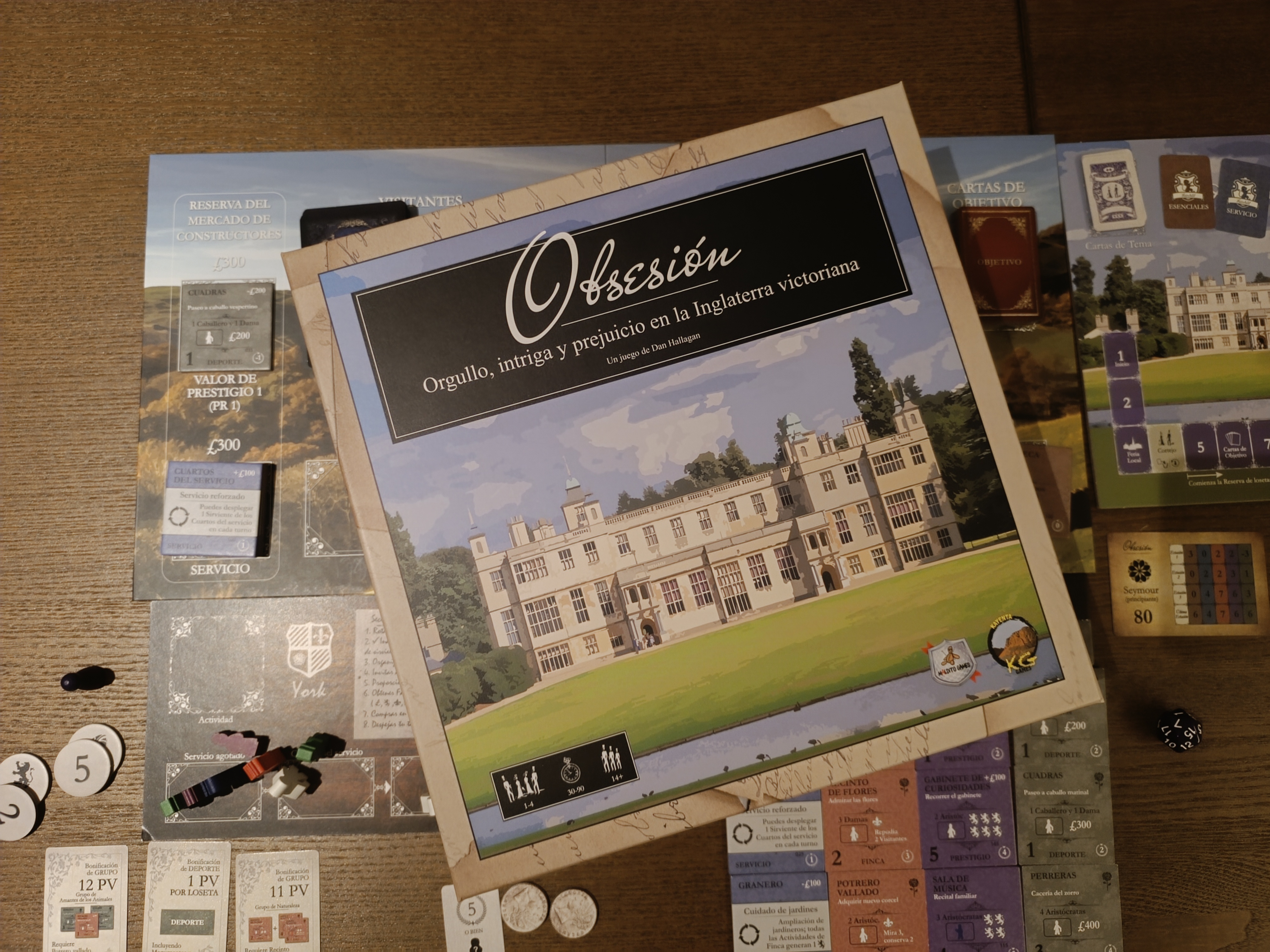
Obsession box
Theme
In Obsession, you are the head of a fallen family in Derbyshire, England. Your family experienced hard times in the late 18th century and is now hoping to improve its status in the mid-19th century. One way to improve your standing is through marriage, and it happens that two orphans from the wealthy Fairchild family are of marriageable age in Derbyshire.
As the head of your family, you’ll improve your estate, organize social events, invite aristocrats as guests, and hire servants to enhance your reputation.
How to Win
To win, you need the most victory points. Points are earned from:
- Country estate improvement tiles
- Guest cards
- Victory point cards gained during the game
- Reputation (converted to points using a table in the rulebook)
- Objective cards
- Servants (2 points each)
- Money
Components
The game includes:
- A main board where activities are displayed
- A board with the turn tracker
- Personal boards (one for each of the 4 families in the base game)
- Player materials
- Meeples in several colors representing servants
- Cards: guest cards (levels 1 and 2), victory point cards, theme cards, and objective cards
- Country estate improvement tiles stored in a bag.
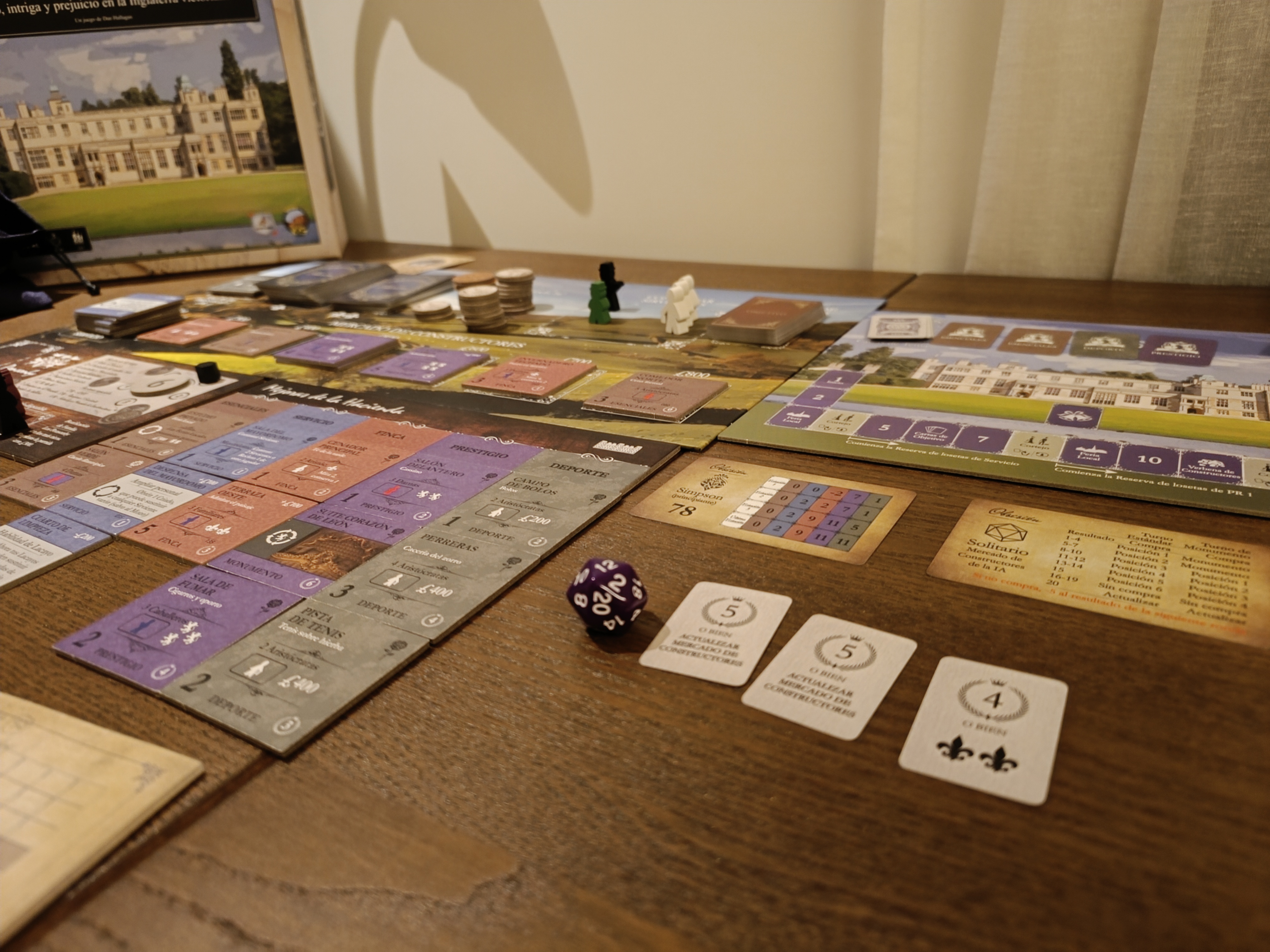
Obsession game boards
The Four Families
Each family provides a unique starting advantage.
- Cavendish starts with a reputation token on level 4 of the reputation wheel (closer to reaching reputation 2) while other families start on level 1
- Asquith starts with one extra card, an additional family member
- Ponsonby starts with £300
- York starts with an extra footman servant
Setup
Set up the two boards. On the board with the round tracker, place the round marker on the first space and shuffle the victory point and theme cards onto their designated spots.
On the main board, place the guest cards and objective cards. Put all tiles except monuments into the bag. Select the number of monuments indicated in the rulebook based on player count, then add them to the bag. Draw 6 tiles from the bag to create the tile river. Only tiles of levels 1-3 and specific services listed in the rulebook are accepted for setup — return any others to the bag. Sort the tiles in ascending order on the board and stack duplicate tiles.
Prepare each player board by placing the reputation level token on “1” at the center of the reputation wheel, then place your reputation tracking token on level 1 of the wheel (or level 4 for Cavendish). Add the 5 starting servants to your available services. Shuffle the starting casual guests and distribute 2 to each player to add to their 4 family cards (or 5 for Asquith).
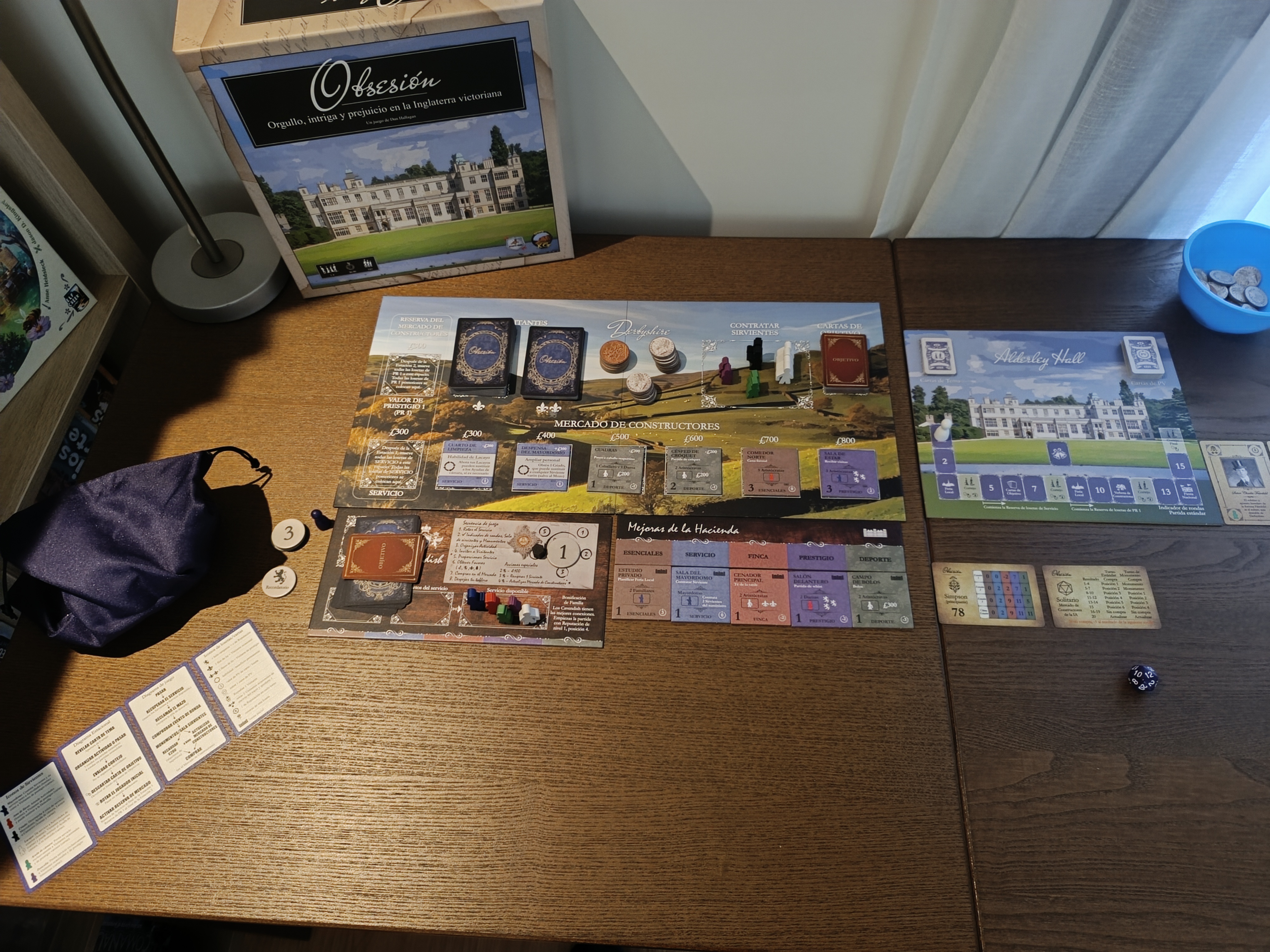
Setup for one player
The Reputation System
Your player board features a reputation wheel with 5 levels around it and a reputation level tracker in the center. As you gain reputation during the game, you advance your token around the wheel. When you complete the 5th level of the wheel, you increase your reputation level by 1 point (moving the center token from 1 to 2, for example) and your tracking token returns to level 1 of the wheel to begin the cycle again.
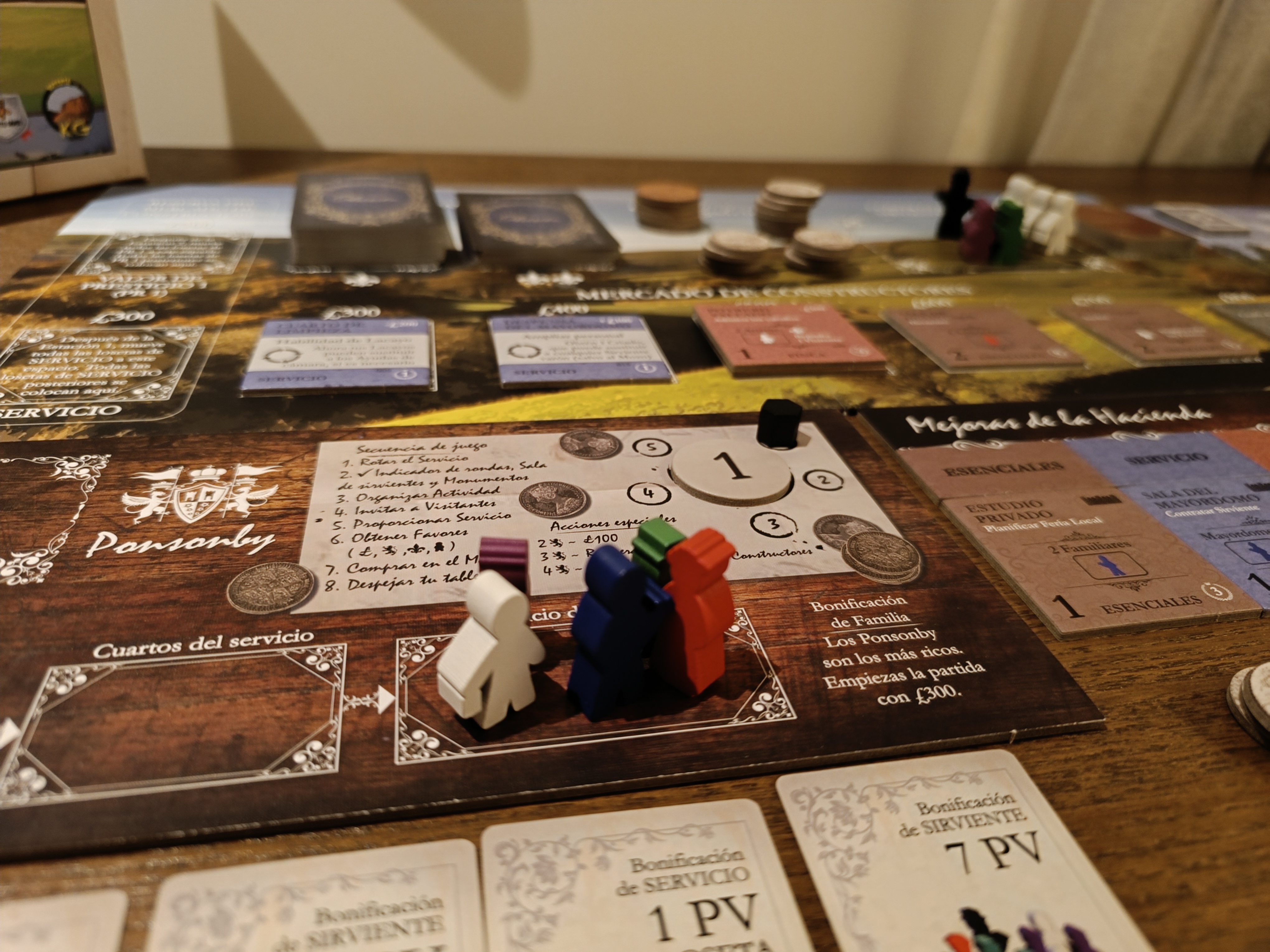
Reputation wheel and available servants
Gameplay
The game spans 16-20 turns depending on whether you’re playing normal or extended gameplay. In solo mode, games typically last around 45 minutes.
Your Turn
On your turn, select a country estate improvement tile from your estate to host an event. Choose exactly the number of guests indicated on the tile from your hand and assign the required servants to the event. While you cannot choose which guest cards you acquire (they come from the common pool), you do have control over which country estate improvement tiles you purchase — this strategic tile selection is key to building your engine.
You can only use servants that are currently available. After performing an event, servants move to “used services.” At the start of your next turn, servants rotate from “used” to “servants’ quarters” and from “servants’ quarters” to “available services.” Only available servants can be assigned to events.
Events and guests provide bonuses or penalties related to reputation, acquiring new guests, money, or servants.
After resolving effects, if this is the first time you’re using this improvement tile, flip it to its other side. The tile now shows different points, requirements, and effects.
You then have the option to purchase a new tile. You can only acquire one tile per turn. The cost is shown on the board and may be modified by tile effects.
The Five Improvement Types
Country estate improvements come in 5 types:
- Essentials: basic improvements for your estate
- Services: usually don’t host events but provide benefits for servants
- Estate: core estate buildings
- Prestige: high-status improvements
- Sporting: outdoor and recreational facilities
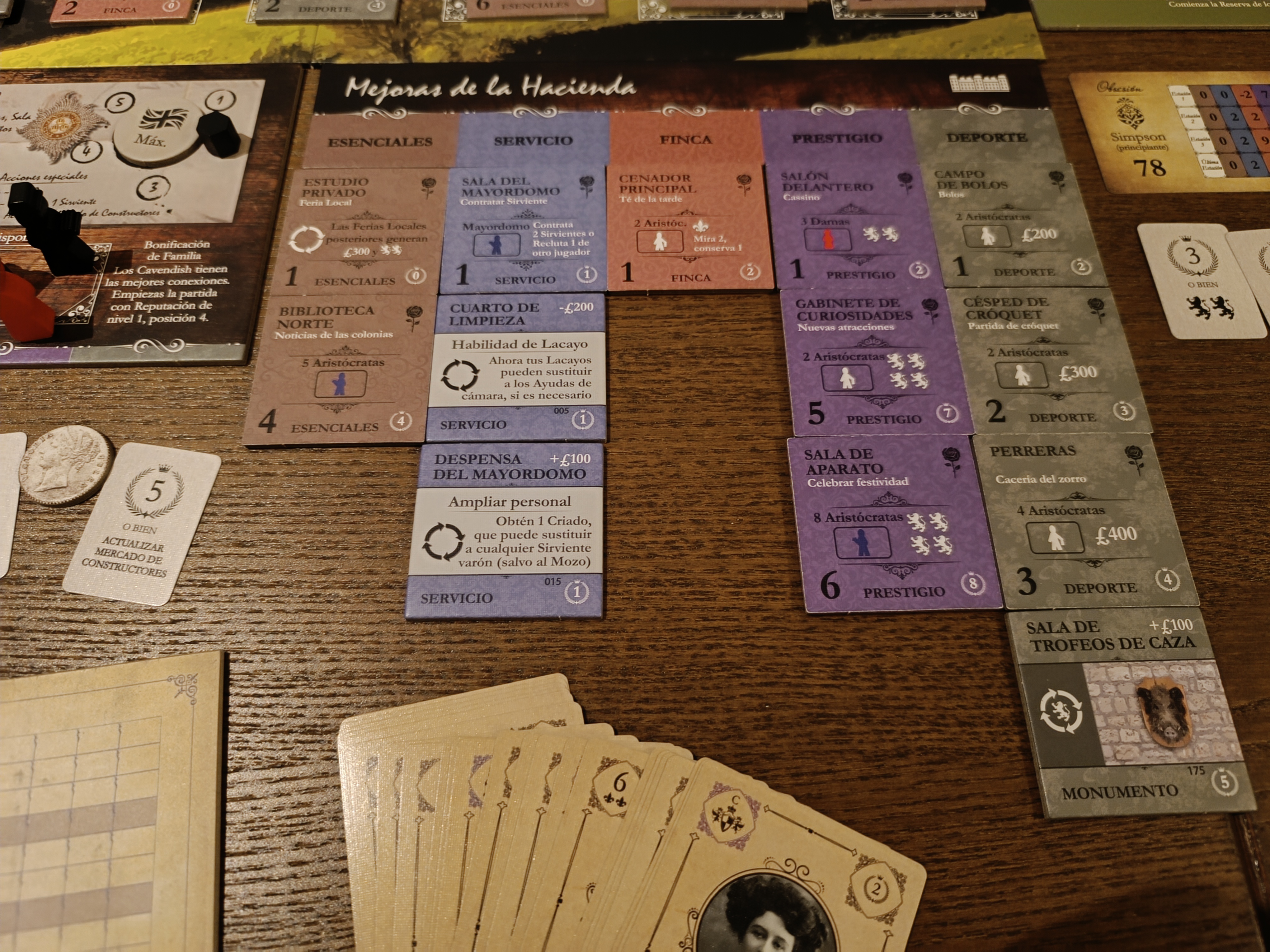
Country estate improvements at the end of the game
The Importance of Reputation
Reputation is crucial in Obsession. You cannot play guest cards or country estate improvements if your reputation level is lower than the requirement shown on the card or tile. Higher reputation unlocks better guests and improvements with superior benefits. Managing your reputation carefully is key to success.
Special Events
Certain turns trigger special events as:
- Village Fair: if you’ve flipped the Study tile, gain £300 and 3 reputation.
- Opportunities: gain additional objectives (you must discard one objective at each courtship event), host events and invite guests above your reputation level, or build additional buildings this turn.
Courtship Events
During the game, there are 4 courtship event phases. On these turns, you don’t play a tile but instead resolve a thematic event. The Fairchild orphans attend your events during these phases.
A card is revealed showing the theme for that phase, corresponding to one of the 5 improvement types. You count the points from tiles of that specific type in your estate. The player with the highest points gains one of the Fairchild cards to play this turn plus a victory point card. In case of a tie, the Fairchilds don’t join any family, but tied players each take a victory point card.
On the final courtship event, instead of counting points from only one improvement type, you count points from all themes revealed throughout the game. If a theme appears twice, count its points twice. The player with the most points gains a Fairchild card worth 8 VP plus a victory point card.
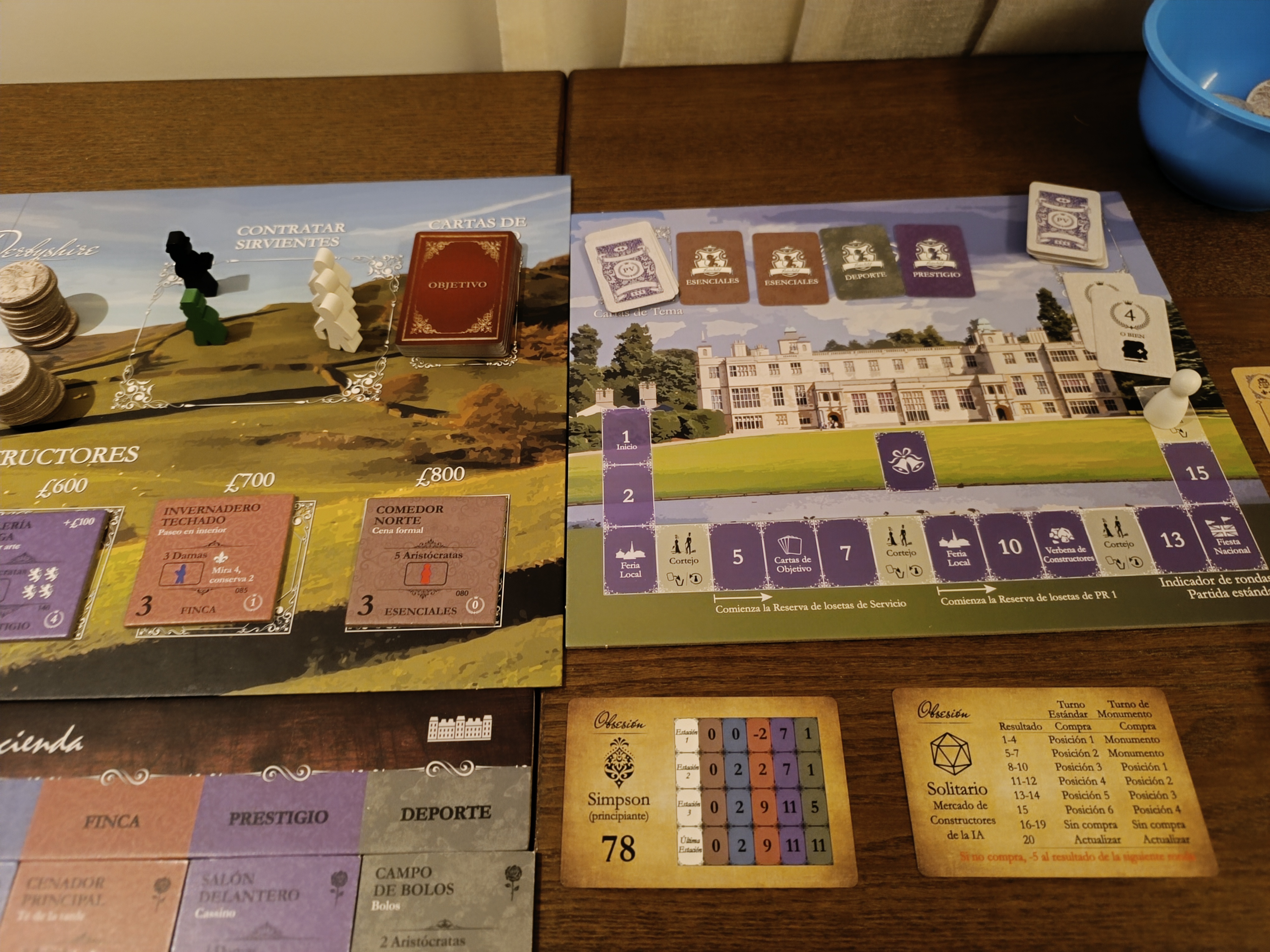
Courtship events. In this example 2 Essentials, 1 Sporting and 1 Prestige
End of the Game
When all turns have been played, count your points to determine the winner.
Component Quality
I really appreciate the material quality in this game. The cards and tokens are excellent quality. Inside the box, you’ll find dividers organizing the material, one section for each family with their respective cards and materials, plus two sections for remaining components. The bag provided for tiles is large and high quality. The illustrations give a Downton Abbey vibe that’s very pleasant.
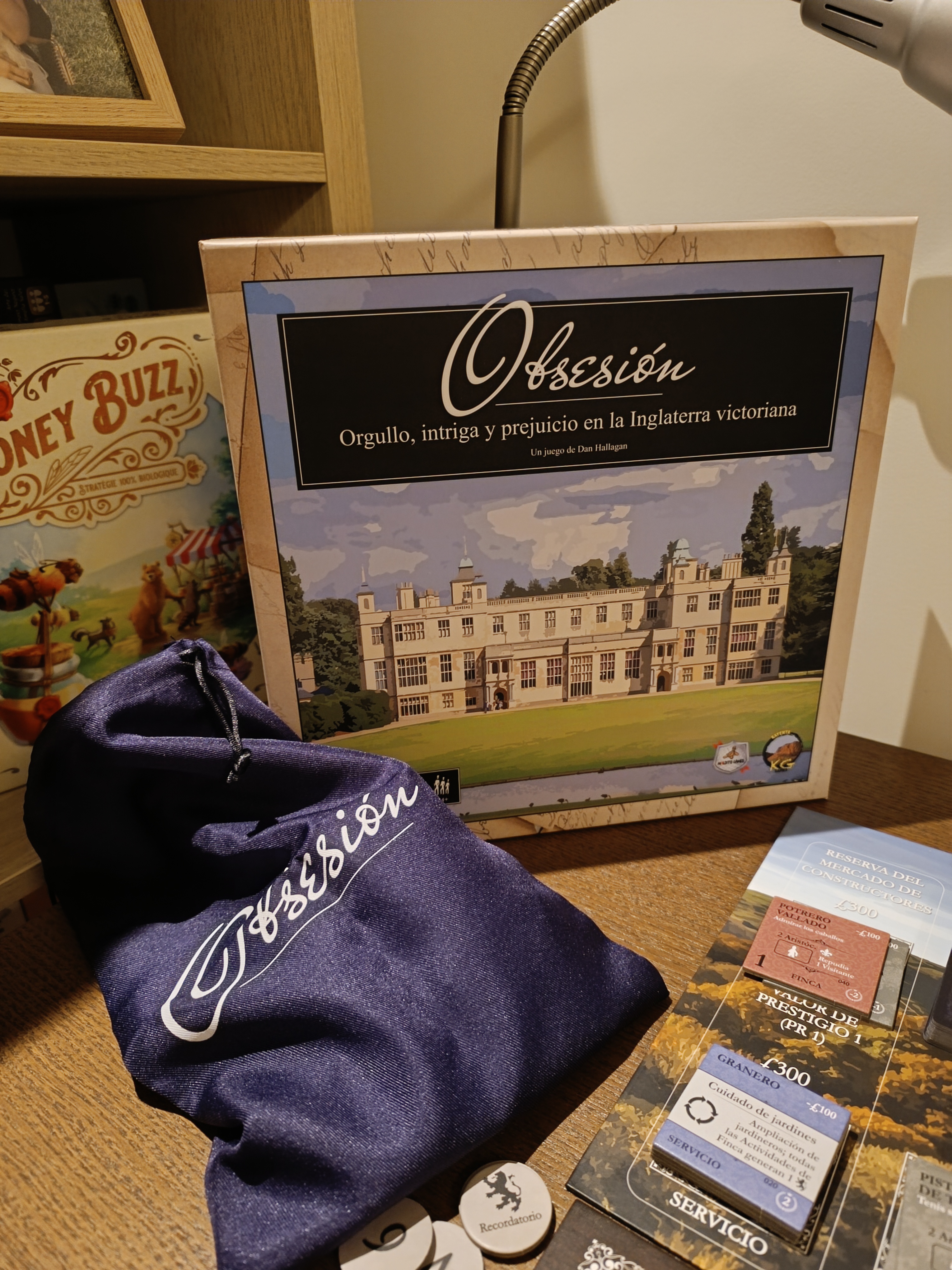
Big bag to shuffle the tiles
Solo Mode
The solo mode features an automa opponent you must beat. There are 3 difficulty levels, each with 3 sub-levels.
The solo mode is simple to manage, using only 2 cards and a 20-sided die:
- One card shows the automa’s score and victory points by color to consider in each courtship event phase
- Another card indicates which tile to remove from the market based on the die roll, with different tables for turns with and without monuments.
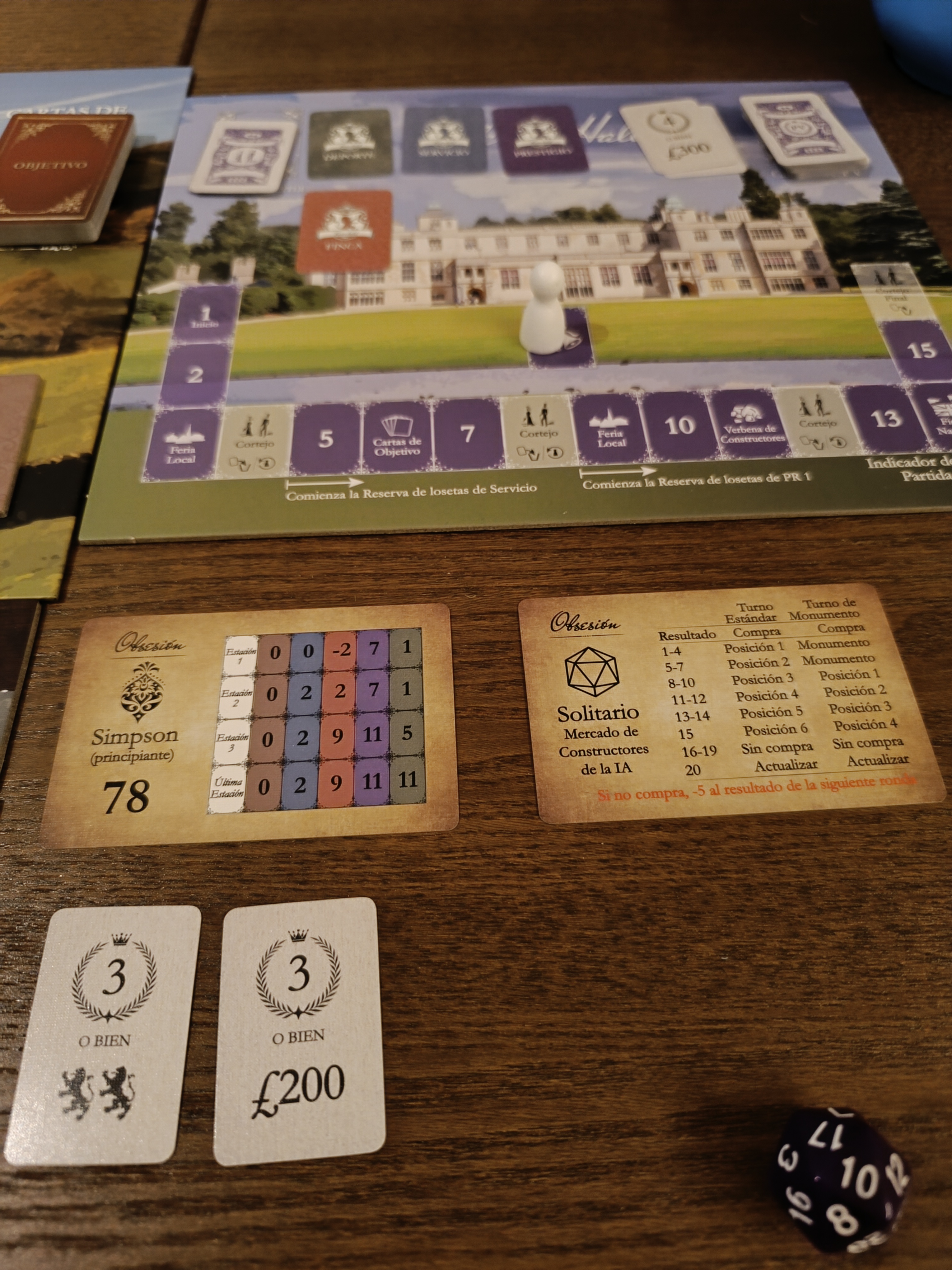
Solo automa material
My Experience
I’ve played 3 times, testing three different families: first Cavendish, then Ponsonby, and finally York. I used the easiest solo mode for all three games.
I won my first 2 plays at the basic level and thought it was easy. But as soon as I tested the second difficulty level, it became much harder, and I understood the full beauty of the game. Each family plays quite differently — starting closer to reputation 2 (Cavendish) versus extra money (Ponsonby) versus an extra servant (York) creates distinctly different strategies.
My Rating
Rating: 9 out of 10
The gameplay is fantastic, quick, easy to prepare, and really enjoyable. Solo games take around 45 minutes, which is perfect. The theme is present but not overwhelming, which is good for players who aren’t enthusiastic about Victorian themes. The solo mode is enjoyable and not easy to beat, with scalable difficulty that keeps you coming back. I’ll probably return to this game often and possibly purchase the expansions.
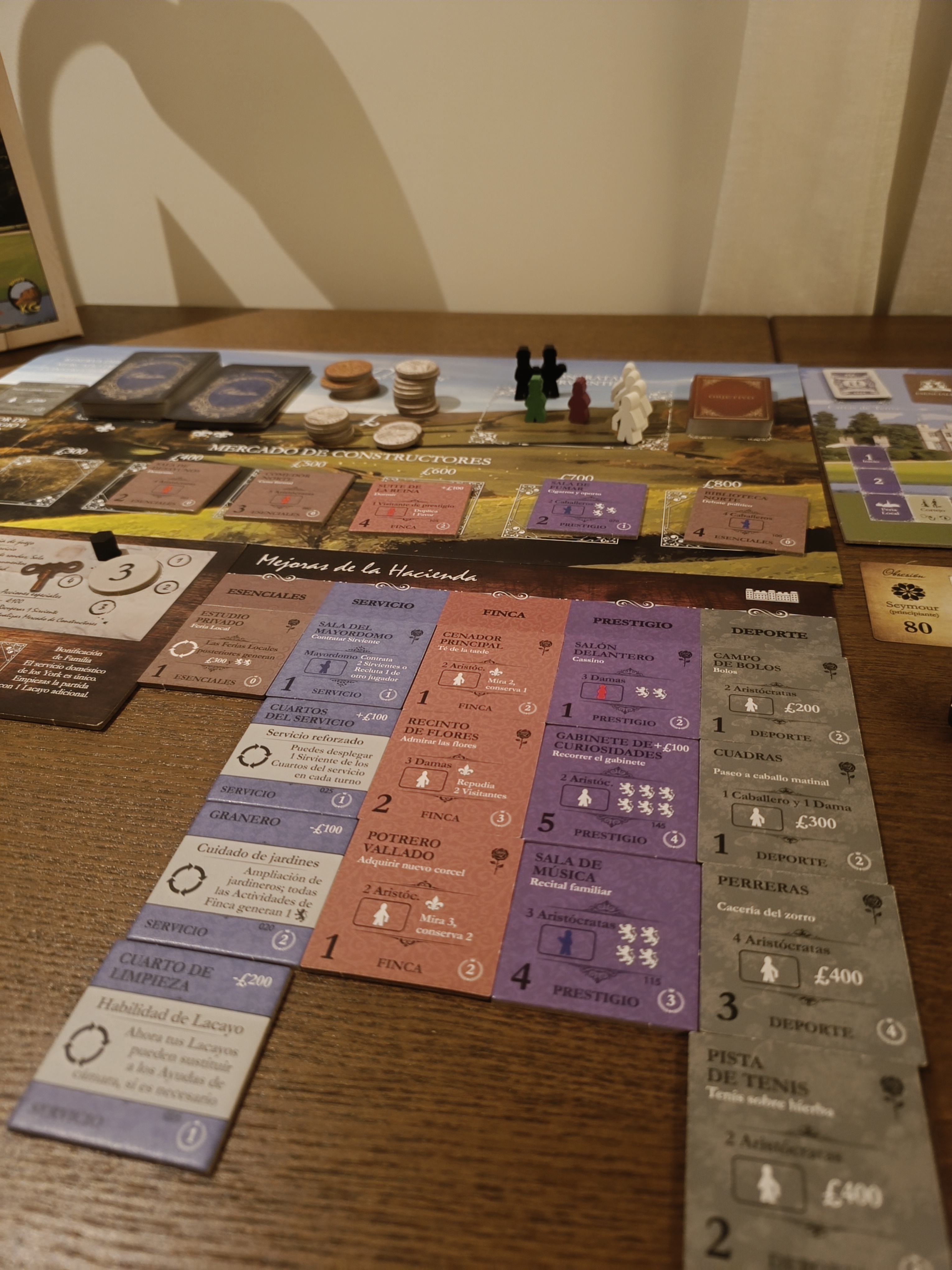
End of game
Final Thoughts
Obsession beautifully integrates hand management with servant management in a thematic Victorian setting. While guest acquisition is somewhat random, you have full control over which country estate improvements you add to your estate, allowing you to build toward specific strategies. The courtship mechanics add tension and strategic depth, while the servant rotation system creates interesting tactical decisions. Reputation management is crucial — you must carefully balance building your reputation with acquiring the cards and improvements you need.
Component quality is excellent, and the solo mode provides a solid challenge with scalable difficulty. The four families offer meaningful variety in starting positions and strategies.
If you enjoy thematic games with elegant mechanics, hand management, and appreciate Victorian-era settings (or at least don’t mind them), Obsession is highly recommended.
Your Turn
Have you played Obsession? Which family did you play? How did your courtship events go? Have you tried the expansions?