Hello everyone!
Today I want to talk about a game that has been sitting proudly on my shelf for a while now, Merchants Cove. A beautiful, heavily asymmetric Euro game where every player is basically playing a completely different game. Sounds wild, right? Well, let me tell you all about it.
Game Overview
Merchants Cove is a 2020 release for 1 to 4 players, ages 14+, with a playtime of 60–90 minutes. It was designed by Jonny Pac, Carl Van Ostrand, and Drake Villareal, illustrated by Mihajlo Dimitrievski, and published by Final Frontier Games.
The Spanish version is published by TCG Factory and the French version by Super Meeple.
A note for those interested in collecting the full game: Final Frontier Games has unfortunately closed its doors. The Merchants Cove: Master Craft expansion, their final big-box release, was a Kickstarter project that did ship, but the publisher is no longer operating. I was lucky enough to find physical copies of the base game and early expansions through Spanish retailers, and a French edition of Master Craft through a French store. If you are on the hunt, copies can still be found through some retailers and the secondary market.
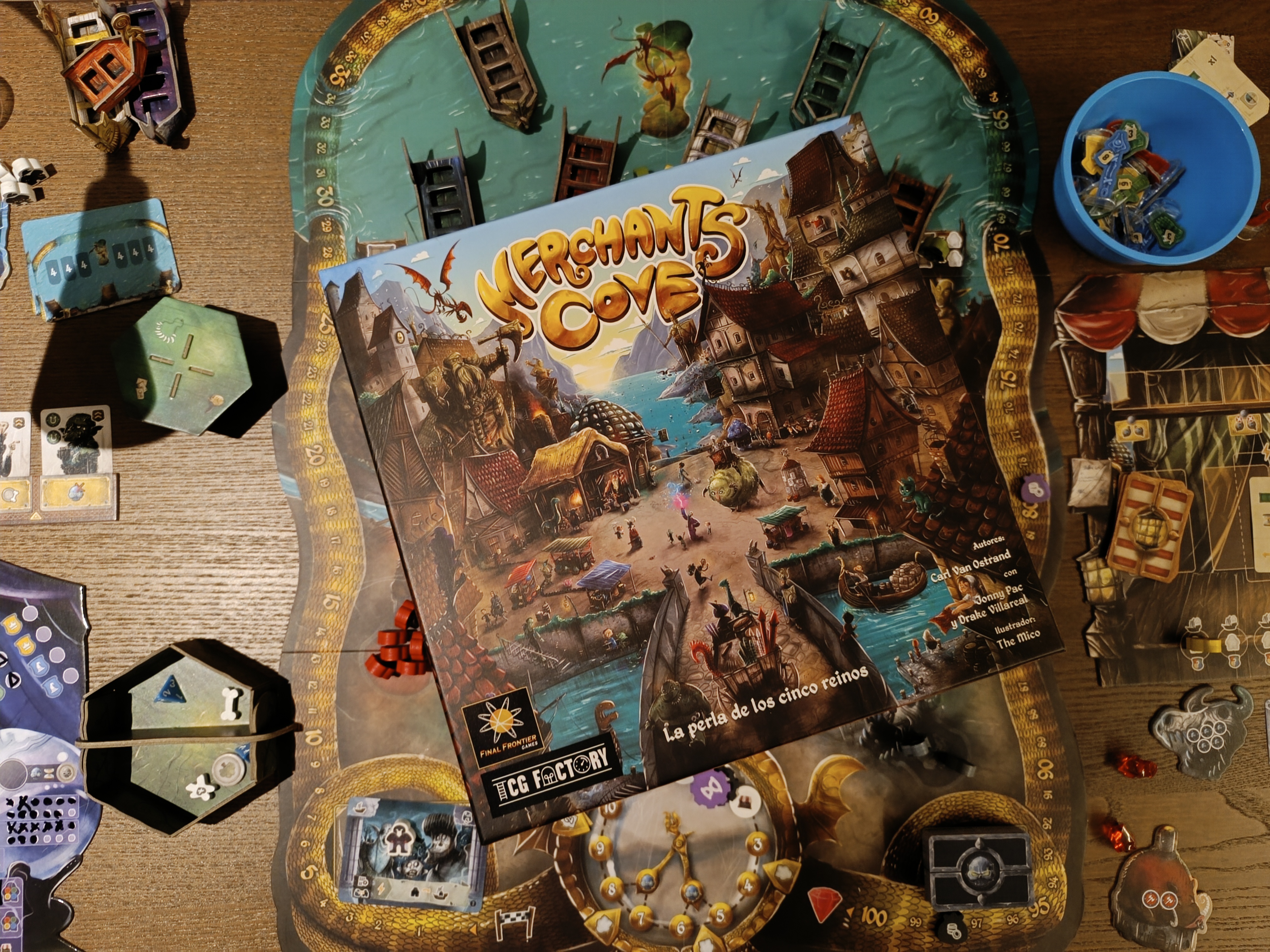
Merchants Cove box
Theme
Welcome to Merchants Cove, a bustling port city in the Five Realms. You are not an adventurer here, you are a merchant, and your job is to sell goods to the adventurers who arrive by boat each day, loaded with gold from their quests.
The adventurers come from five different factions, each represented by a colour. The red and green factions are the most common, which means the goods they want are worth less. The blue and yellow adventurers are rarer and more valuable. And then there are the grey ones, the Rogues. You won’t be selling to them, but ignore them at your peril: they will cost you negative points at the end of the game if you can’t manage them.
Each merchant is fully asymmetric, bringing their own board, components, and mini-rulebook. The Alchemist brews potions, the Blacksmith forges weapons, the Captain sails the seas for fish and treasure, and the Time Traveler (a chronomancer, if you want to get fancy about it) collects relics from across time. Every merchant feels like a different game, and that is very much the point.
How to Win
The goal is to end the game with the most gold. You earn gold primarily by selling goods to adventurers during the market phases, but scoring does not stop there. At the end of the game, you also gain bonus gold based on the Faction icons found on your Townsfolk and Corruption cards: for each Faction icon, you earn gold equal to the number of adventurers currently in that faction’s hall. On the flip side, Corruption cards cost you gold at the end, based on how many Rogues are in the Lair, so managing your corruption throughout the game matters more than it might first appear.
If players are tied on gold, the tiebreakers are: most unsold goods remaining on your Sale Shelf, then fewest Corruption cards. If still tied, victory is shared.
How to Play
Setup is not quick. There is quite a lot to prepare: the main board needs the boats arranged (three on each side), the Townsfolk market set up for hiring, the corruption cards shuffled and ready, and the clock, the game’s central timing mechanism, positioned and ready to track the pace of each round.
On your turn, you move your miniature to a new space on your personal merchant board to perform an action. You cannot repeat the same action twice in a row, you must always move to a different space. Two actions are shared across all merchants: recruiting a Townsfolk and activating your Townsfolk workers. Everything else is unique to your merchant, which is why each one comes with their own small rulebook.
Some actions come at a cost: certain spaces on your board, and some Townsfolk you recruit, will force you to take a Corruption card. Corruption is not immediately punishing, but it accumulates, so deciding when it is worth taking that hit is a constant balancing act.
The clock is central to the whole experience. As you spend hours taking actions, you also advance the clock, and the clock controls when adventurers populate the boats and when the market phase happens. Deciding when to rush ahead versus staying back to produce more goods is one of the most interesting tensions in the game.
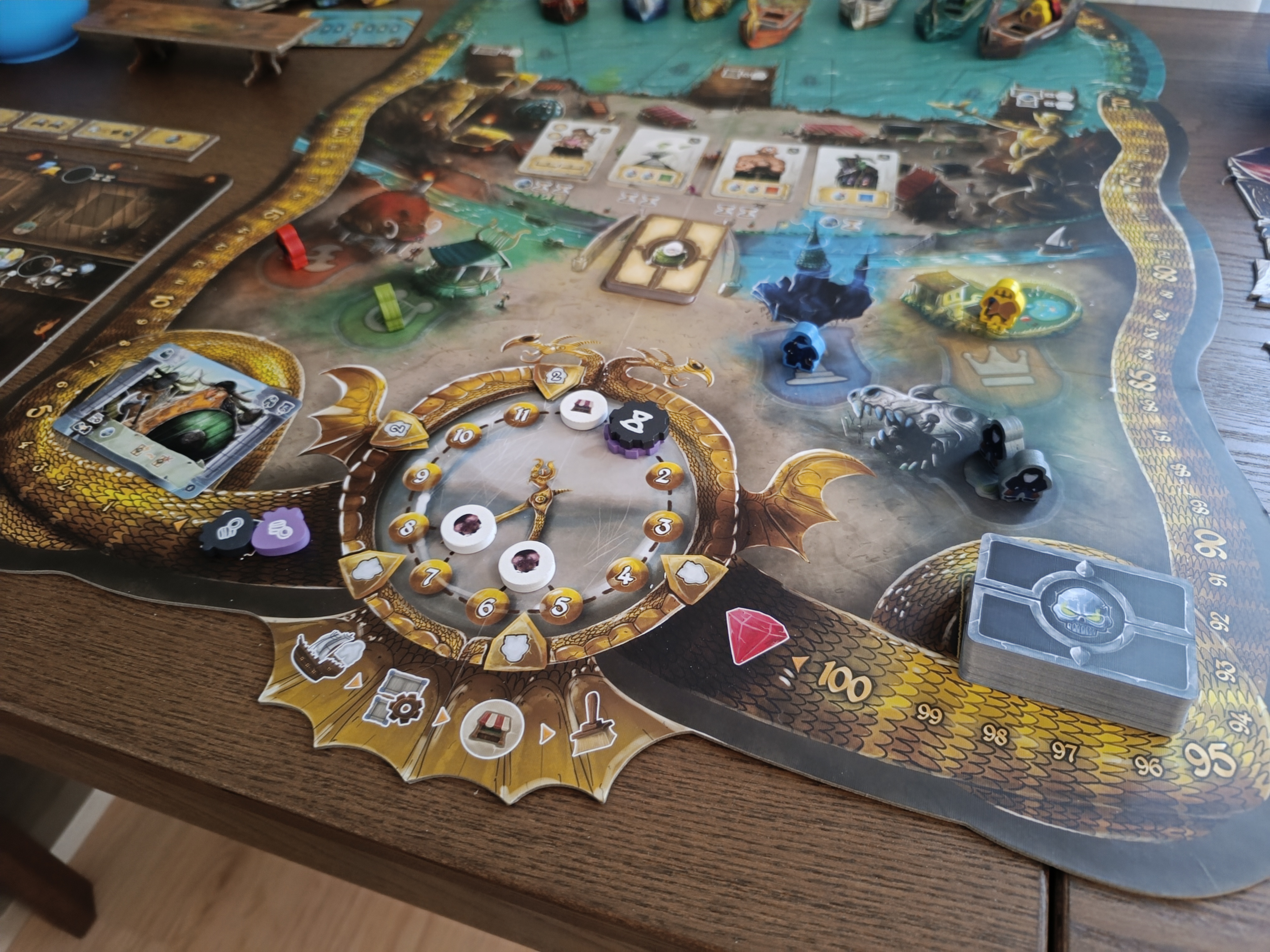
Main board clock
When the clock triggers a market phase, the boats dock at the piers and it is time to sell. Each pier is designated for either small or large goods, and adventurers will only buy from merchants offering the right type. Adventurers are also colour-coded by faction, and the price you earn depends on their rarity. This is where all the planning comes together: the goods you have produced need to match both the size and the faction colour of the adventurers who actually show up. Influencing which adventurers board which boat, and which boat docks at which pier, is where most of the player interaction happens.
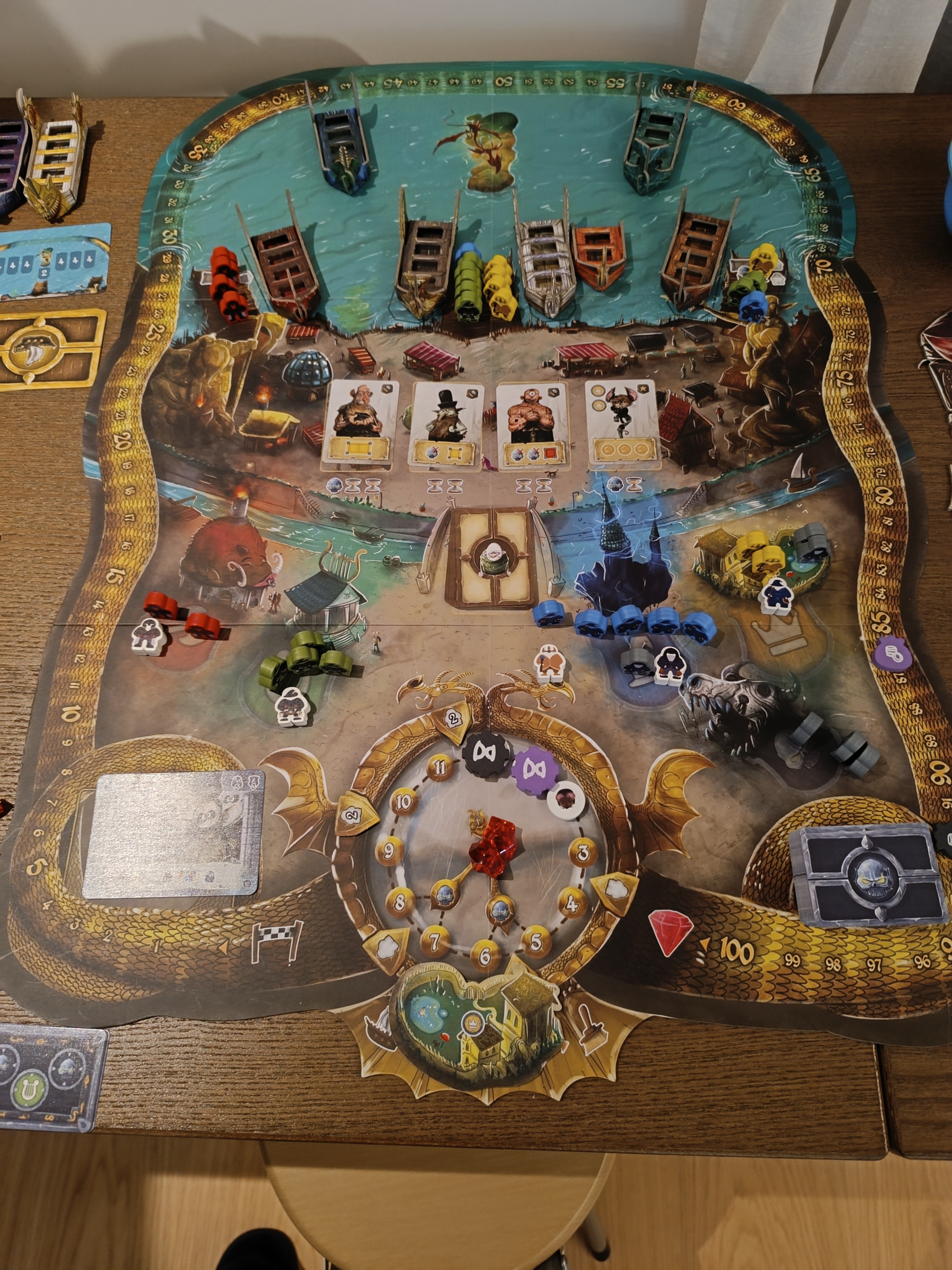
Main Board
The Merchants
The base game includes four merchants: the Blacksmith, the Alchemist, the Time Traveler, and the Captain. Three expansion boxes add three more individual merchants: the Innkeeper, the Dragon Rancher, and the Oracle. And then there is Merchants Cove: Master Craft, which adds four expert-level merchants, the Mushroom Farmer, the Detective, the Treasure Diver, and the Pastry Chef, plus a whole new board expansion called the Faction Festival.
I have tested five of the eleven merchants so far, and here is my personal ranking of those I have played:
- Blacksmith
- Time Traveler
- Alchemist
- Innkeeper
- Oracle
Still waiting on my table: the Captain, the Dragon Rancher, and all four Master Craft merchants. Plenty of discoveries ahead! 😊 The descriptions below cover only the merchants I have actually played.
The Blacksmith
The Blacksmith forges weapons to sell. To forge them, he uses dice of several colours, each forge space has a maximum of points per colour, and you need to match those values with your dice. Managing your dice well is the core puzzle here: you need to think ahead, plan your rolls, and unlock mechanisms that let you manipulate the dice results. It is deeply satisfying when the forge runs smoothly.
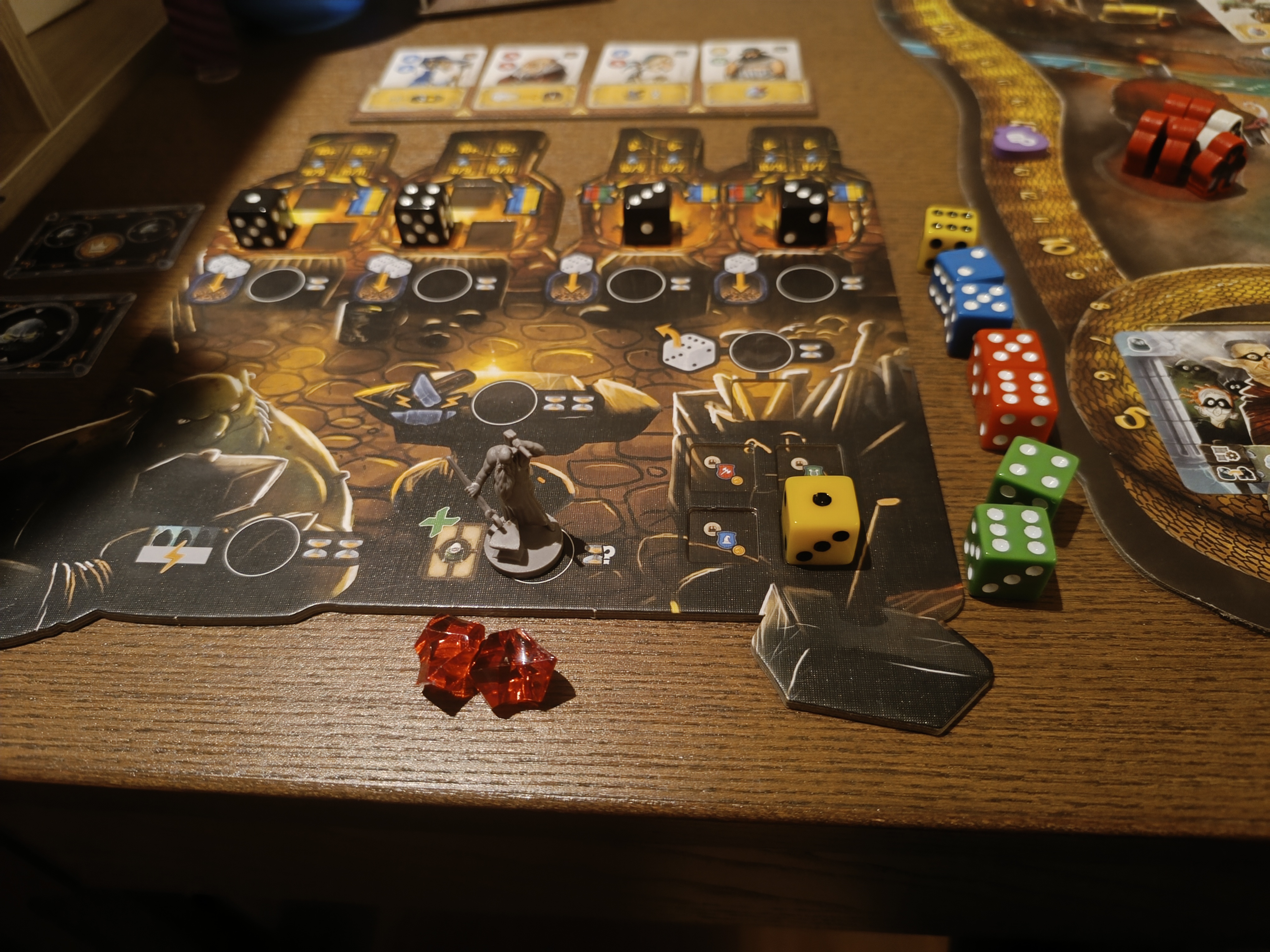
The Blacksmith
The Alchemist
The Alchemist works with ingredients, small marbles representing the raw materials she cultivates in her alchemical garden. She will create potions by gathering ingredients and filling her cauldrons. The key skill here is anticipating which adventurers will be at the piers during the market phase, so you can brew the right potions in advance. Getting ahead of the market is the whole game with the Alchemist.
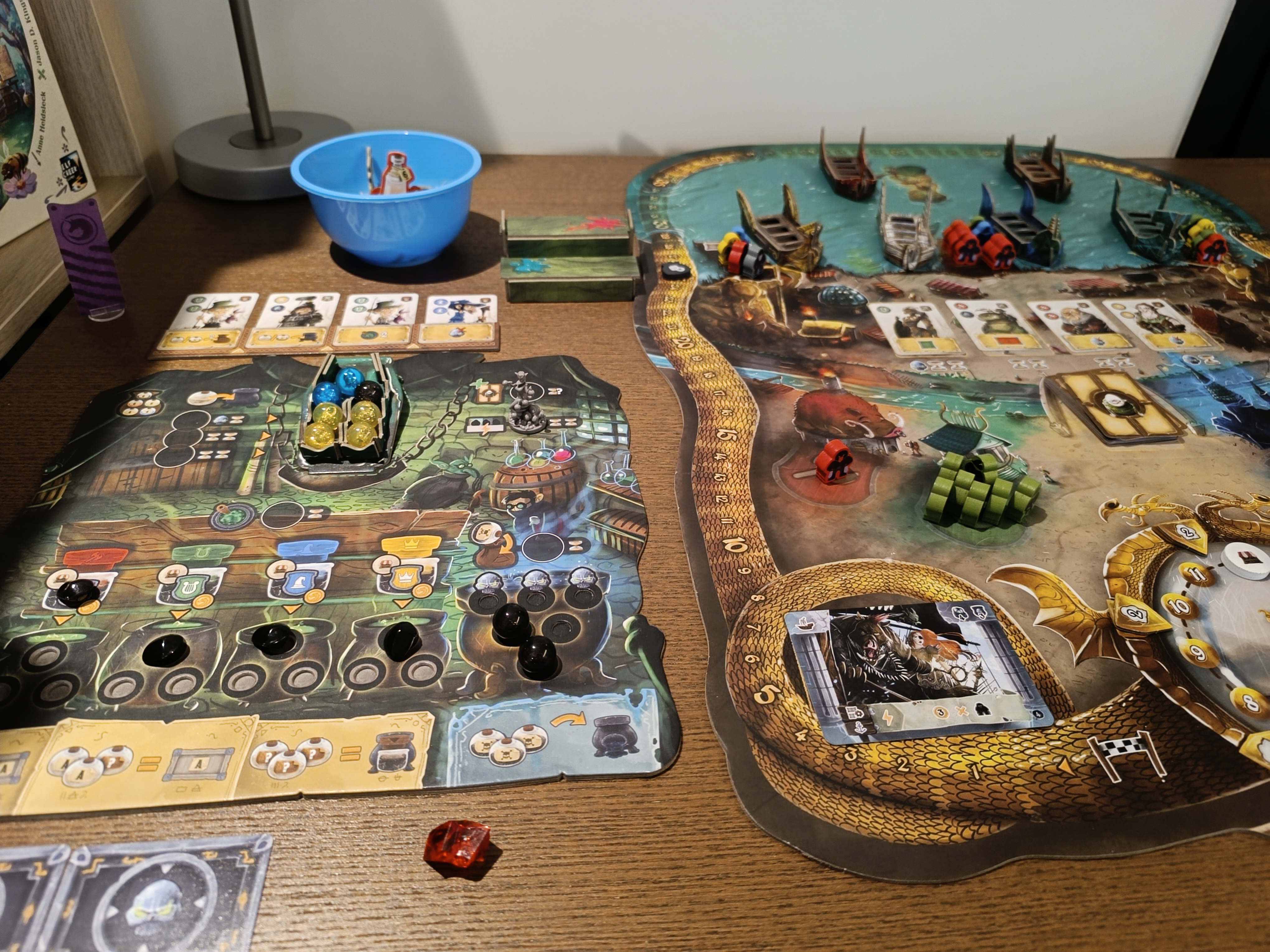
The Alchemist
The Time Traveler
The Time Traveler has a notable difference compared to the other merchants: he has two miniatures, the Traveler and the Assistant. They work together, but one cannot pass the other on the board, which creates a fascinating constraint. The actions are not fixed spaces either: you manipulate tiles during your journey to create a sequence of actions that can be highly efficient, or quite punishing if you are not careful. It is a rich management puzzle and my second favourite merchant overall.
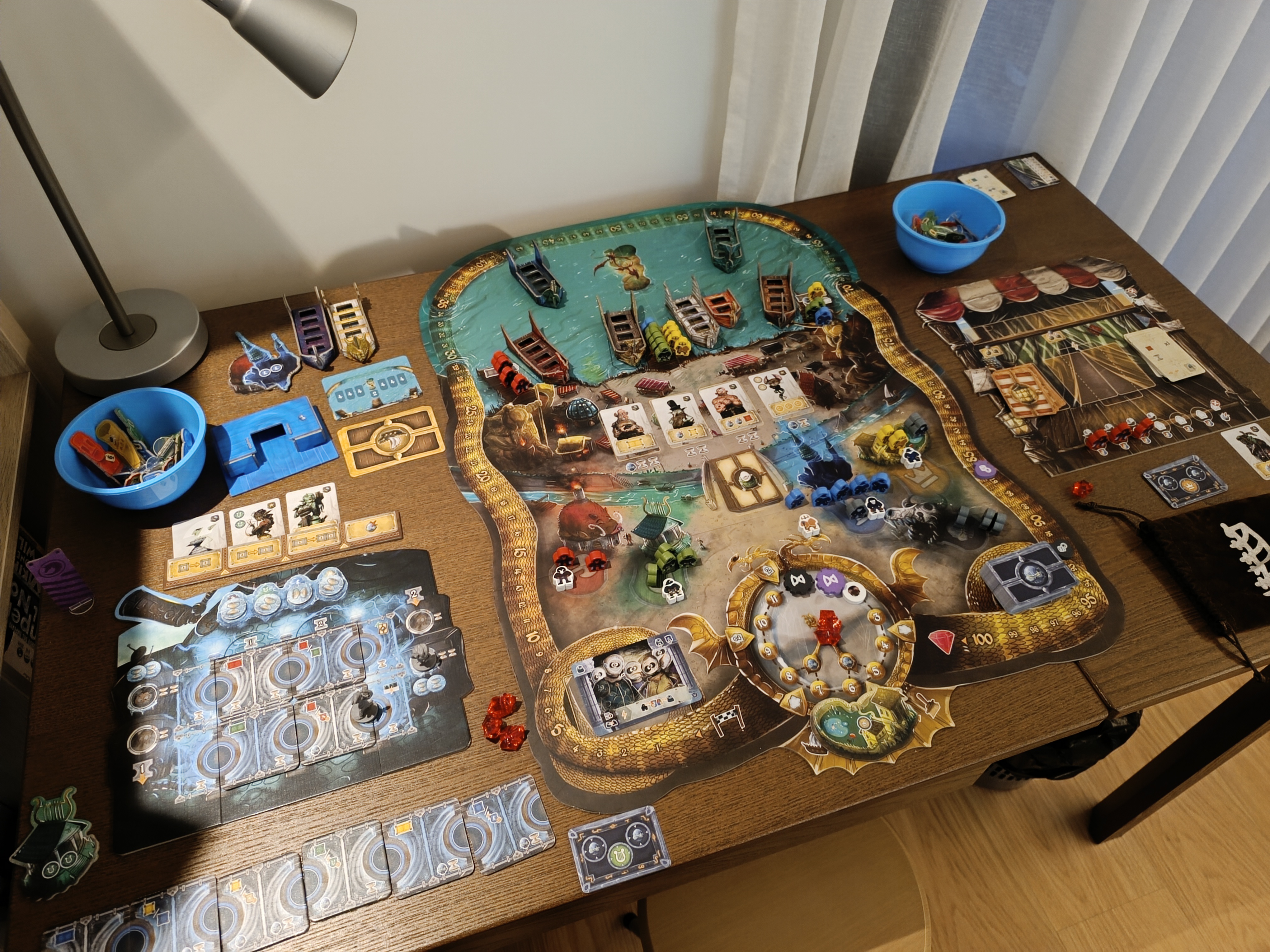
The Time Traveler
The Innkeeper
The Innkeeper does not create goods in the traditional sense. Instead, he sells drinks at the tavern and rents beds to tired adventurers. For small goods, he sells directly at the piers; for larger goods, he brings adventurers to his board to sleep in a room. At the end of the round, those adventurers move to the tavern to sit around tables. If there is no space for an adventurer, or no room in their faction colour, they become unhappy, cause trouble, and give you negative points if you cannot resolve the conflict. A fun mechanic but one that requires careful planning.
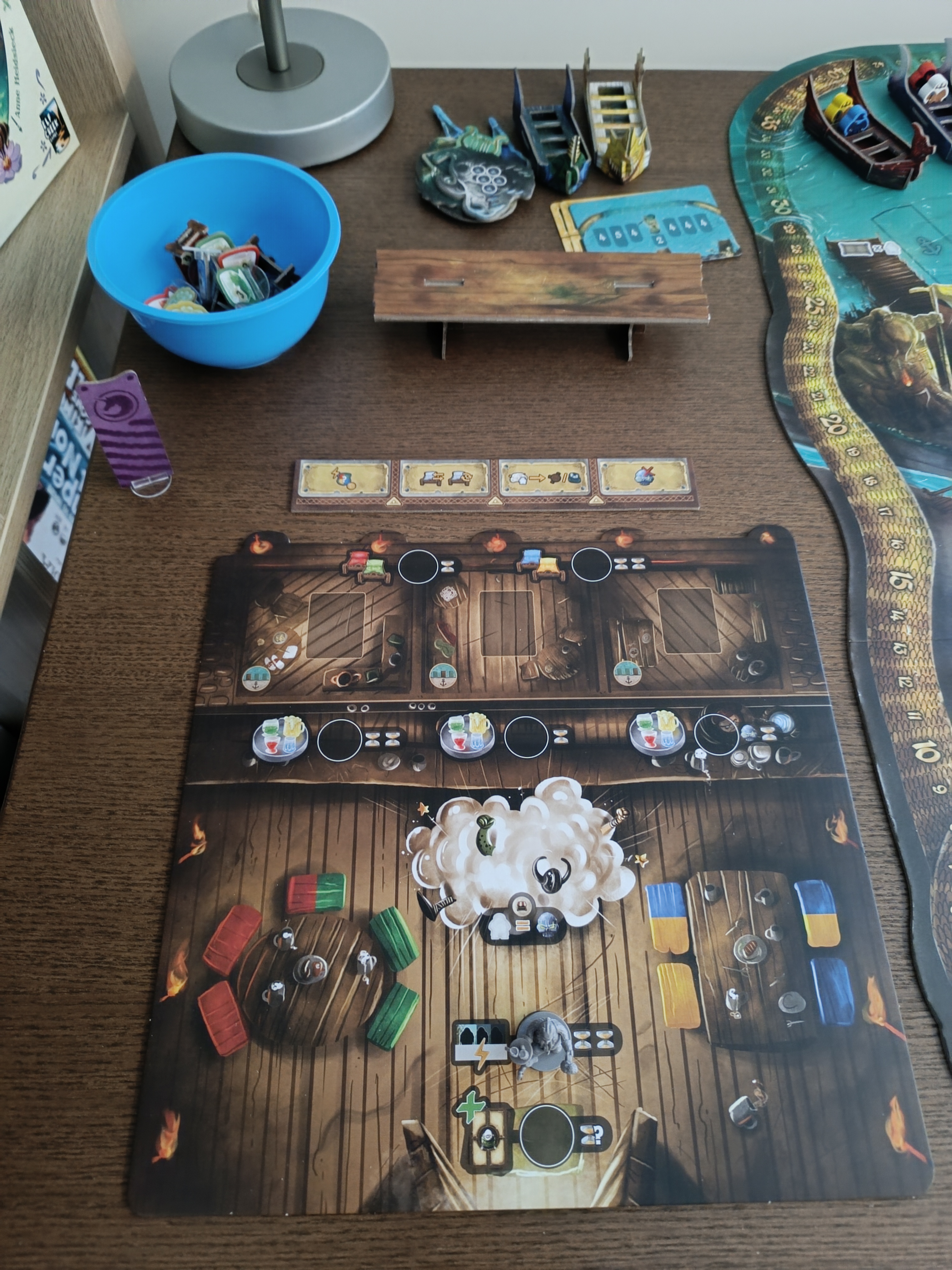
The Inkeeper
The Oracle
The Oracle uses a board that feels very similar to Welcome to the Moon, a roll-and-write style mechanic with a dry-erase board. Each turn, you throw a handful of runes (a coin, a bone, a voodoo meeple, and dice) into a divided tray, then record the results on your board in various ways: reading the stars, predicting the future with bids, entering sequential numbers to gain resources, and more. The twist is that the outcome of the throw, which half of the tray each piece lands in, determines which actions are available to you.
It is a fun mechanic, but honestly, the Oracle was the most confusing merchant I have tested so far. Enjoyable, but it took the longest to feel comfortable with.
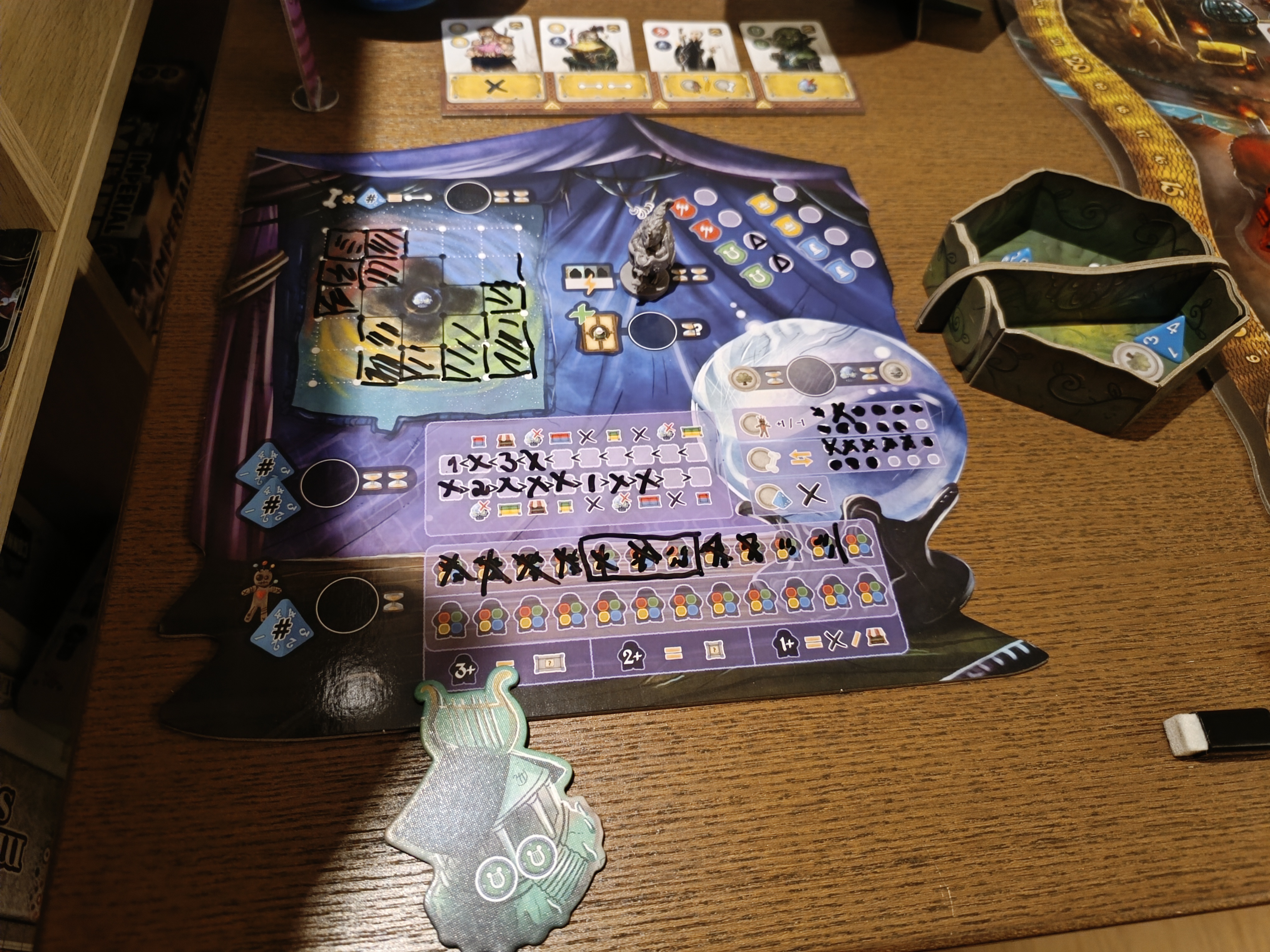
The Oracle
Component Quality
The production quality of Merchants Cove is excellent. The cards are thick, the meeples feel solid, and the bag used to draw adventurers is sturdy and satisfying to use. Each merchant comes with their own set of unique components, and there is a lot of material in the box, but the insert does a great job of keeping everything organised. I currently have six boxes for Merchants Cove, the base game, the three individual merchant expansions, the Secret Stash, and the Master Craft, two of which are large boxes. Final Frontier Games did release an official big box designed to house the entire collection in one place, but the price was too steep for me, so I decided against it. If you are building the full collection, it is worth knowing it exists, even if it is now harder to find.
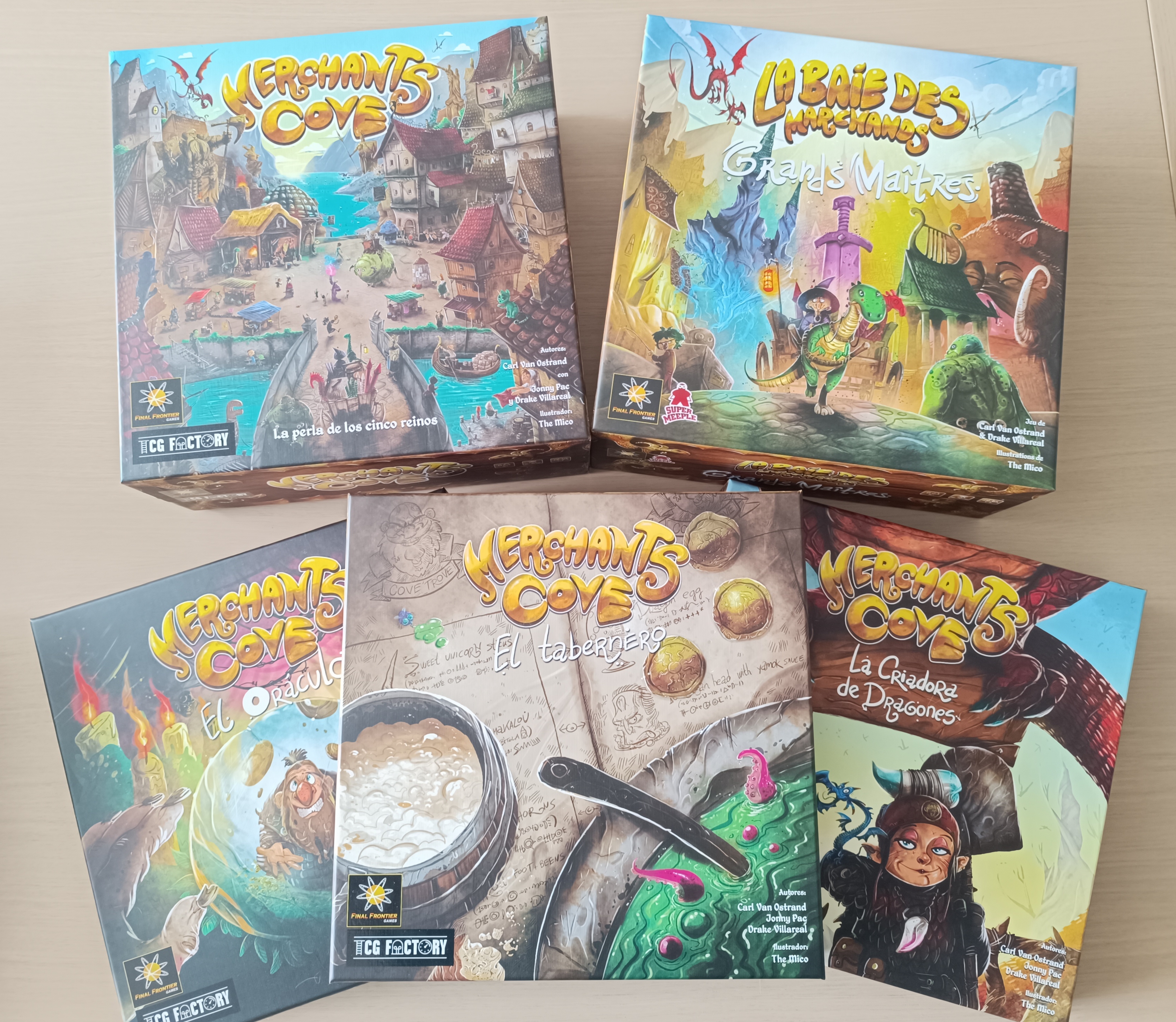
Full Collection
The 3D cardboard boats on the main board deserve a special mention. They are gorgeous, and they give the game a real sense of life and immersion at the table. Watching the boats fill up with adventurers before the market phase is genuinely exciting, and it is one of those physical details that a digital version could never quite replicate. The artwork by Mihajlo Dimitrievski is also beautiful throughout, very thematic and immersive, and it brings the world of the Five Realms to life in a way that makes you want to keep playing.
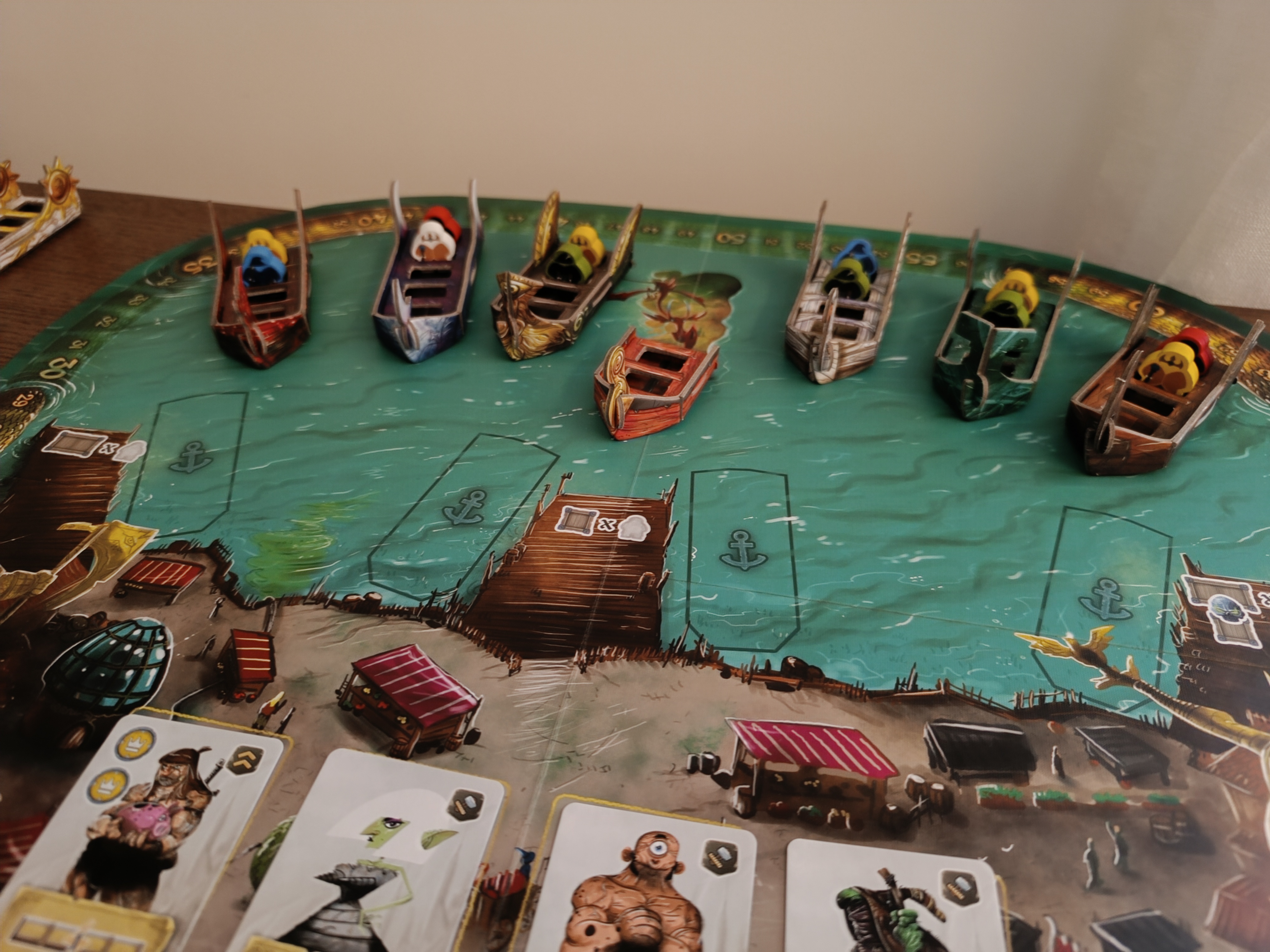
3D cardboard boats
The Secret Stash Expansions
During my plays I have also tested several modules from the Secret Stash expansion. Here is a quick overview of each:
Rogue and Townsfolk cards: These two modules add a significant amount of variety. You select one Rogue card per game, and the Rogue card even suggests which Townsfolk types to pair with it. For Townsfolk, you select two types per game. Both modules keep the game feeling fresh across multiple plays.
New corruption cards: These new corruptions can be discarded by spending a specific type of goods. It adds an interesting balancing act, spend the goods to clear the corruption now, or hold them to sell during the market phase?
New boat sizes and boat setup cards: This module adds boats with five spaces and one boat with only two spaces, along with a set of cards that create a different boat configuration each round. I really enjoy this one for the variability it brings to the market.
Hall of Plenty and Lair of Villainy: These tiles add end-game scoring effects. The player with the most banners of each colour benefits from the Hall of Plenty, while the player with the most corruption suffers a penalty from the Lair of Villainy. It gives you a concrete objective beyond just selling goods and has a significant impact on final scoring.
Faction Leaders: A small module that changes how adventurers are drafted, Faction Leaders count as two adventurers of their colour. It was not my favourite module; the impact felt minor compared to the others.
Dragon Island Festival: This tile adds an end-game bonus tied to the Dragon Island faction hall. A small but fun addition.
Solo scenarios: So far I have only tested one scenario, so it is hard to have a strong opinion. It was enjoyable though, the scenarios add constraints that push you to play differently from a standard solo game.
My Experience
I have played five games solo and a couple at two players a long time ago, and I enjoyed the game in both configurations. The two-player games were a while back so my memory is fuzzy, but I remember the market interaction feeling much more tense with another player actively working against your plans.
At solo you manage an automa that starts simple but can escalate quickly. You need to stay attentive to both your own engine and to what the automa will do next. Sometimes you will need to rush to be the one placing adventurers on boats, just to control where they go and make sure your goods align with what arrives at your pier. It creates a satisfying push and pull that keeps the solo mode from feeling passive.
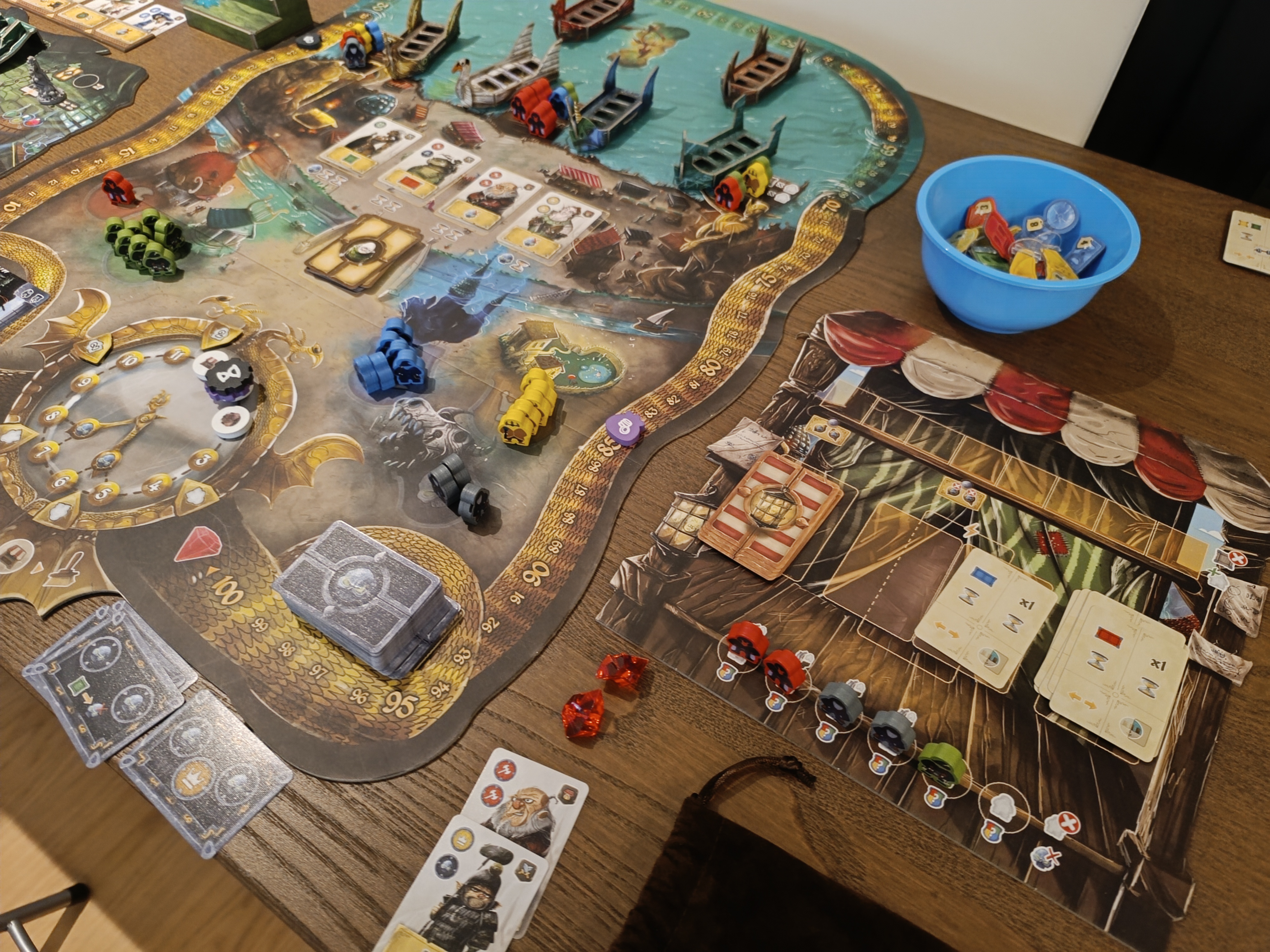
Solo Board
Each merchant I have tried so far has brought a genuinely different experience. The Blacksmith felt controlled and strategic, the Alchemist required more forward planning than I expected, and the Time Traveler surprised me with how much puzzle-solving was packed into such a compact set of rules. The Innkeeper and the Oracle were both fun but more demanding to learn, especially the Oracle, which took a couple of rounds before it clicked.
My Rating
Rate: 7.5 out of 10
Merchants Cove is a game I genuinely love, but one that asks to be played in short bursts. After five plays I started feeling the repetition, not because the game is shallow, but because the core loop of producing goods and selling at the market follows the same rhythm every time. Two or three plays in a row is the sweet spot before you need a break. That said, with eleven merchants in total and all the Secret Stash and Master Craft modules still ahead of me, I have plenty of variety still to discover, and I will absolutely bring it back to the table.
Final Thoughts
Merchants Cove is a gorgeous, ambitious game. The asymmetry is its biggest strength, every time you try a new merchant, it genuinely feels like learning a new game, which is remarkable. The market mechanism, the clock, and the push-and-pull of producing goods versus controlling the piers all come together in a satisfying way.
It is not a game for everyone. If luck-heavy mechanics bother you, this may not be the game for you, there is a fair amount of variability in what adventurers show up and where, and you cannot always control it. But if you love beautiful games with a strong table presence and do not mind a dose of unpredictability, Merchants Cove is well worth trying.
I still have the Captain, the Dragon Rancher, and all four Master Craft merchants waiting on my shelf. Once I have worked my way through them, I plan to come back with a follow-up article covering the full collection. Consider this review part one!
Your Turn
Have you played Merchants Cove? Which merchant is your favourite? And if you have tried any of the Master Craft merchants, the Mushroom Farmer, the Detective, the Treasure Diver, or the Pastry Chef, I would love to hear what you think. I still have a lot to discover! Come share your thoughts on Mastodon.
Related Links
Videos
- Merchants Cove in about 3 minutes - 3 minutes video that explains the essentials of the game
- Merchants Cove - Tutorial & Playthrough - very well explained tutorial
- Merchant’s Cove | Solo Alchemist Playthrough | With Mike - One Stop Co-op Show solo playthrough
- How it Plays: Merchant’s Cove Gameplay and Review - Two player playthrought