Hello everyone!
Today I’m taking you on a journey to the moon! Let me introduce you to Welcome to the Moon.
Welcome to the Moon is a flip & write game with 8 interconnected adventures that can be played standalone or as a campaign. With reusable sheets and compact design, it offers tremendous replayability in a small package. Whether you’re preparing starships, programming flight paths, or establishing lunar colonies, each adventure brings unique challenges and mechanics.
Game Overview
Welcome to the Moon is a 2021 release for 1-6 players, ages 10+, with a playtime of 25-30 minutes. The game was designed by Alexis Allard and Benoit Turpin, illustrated by Anne Heidsieck, and published by Blue Cocker Games.
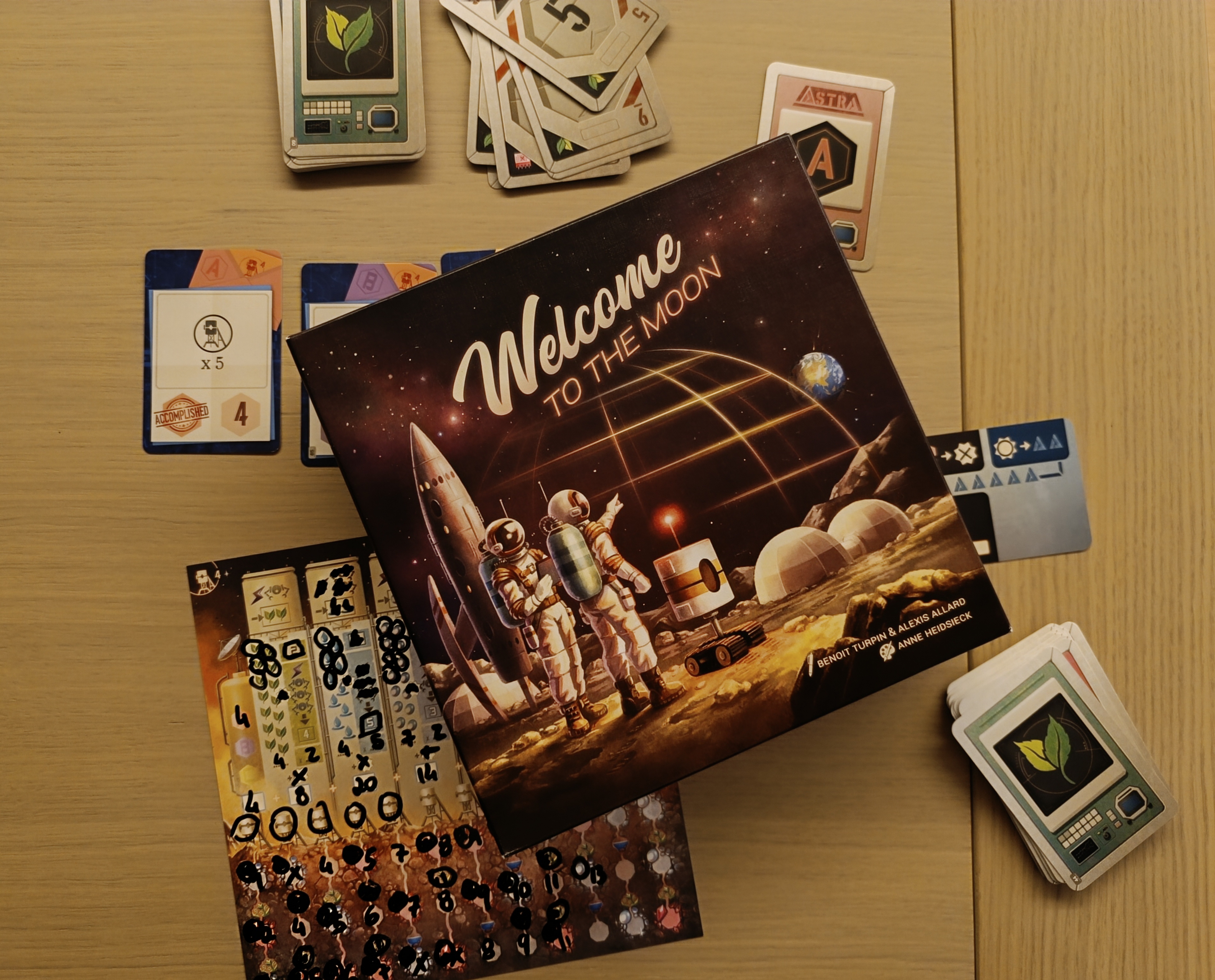
Box
Theme
In Welcome to the Moon, we’re called to colonize the moon as Earth is in bad shape. To succeed, we must first prepare our starship, program our path, and establish our lunar colony.
What Is It?
Welcome to the Moon is a flip & write game, you reveal cards (flipping them from a deck) and write numbers on your personal sheet based on what you draw. The twist? There are 8 different adventures, each with unique sheet designs and special rules, that can be played standalone or linked together in a campaign.
The adventure guide has two modes:
- Learning mode – Guides you through each adventure, as each has unique rules. The core mechanics remain the same, but the sheet designs mean numbers are placed differently.
- Campaign mode – A connected narrative where each result influences the next adventure. Cards are hidden and revealed during gameplay, creating an evolving story.
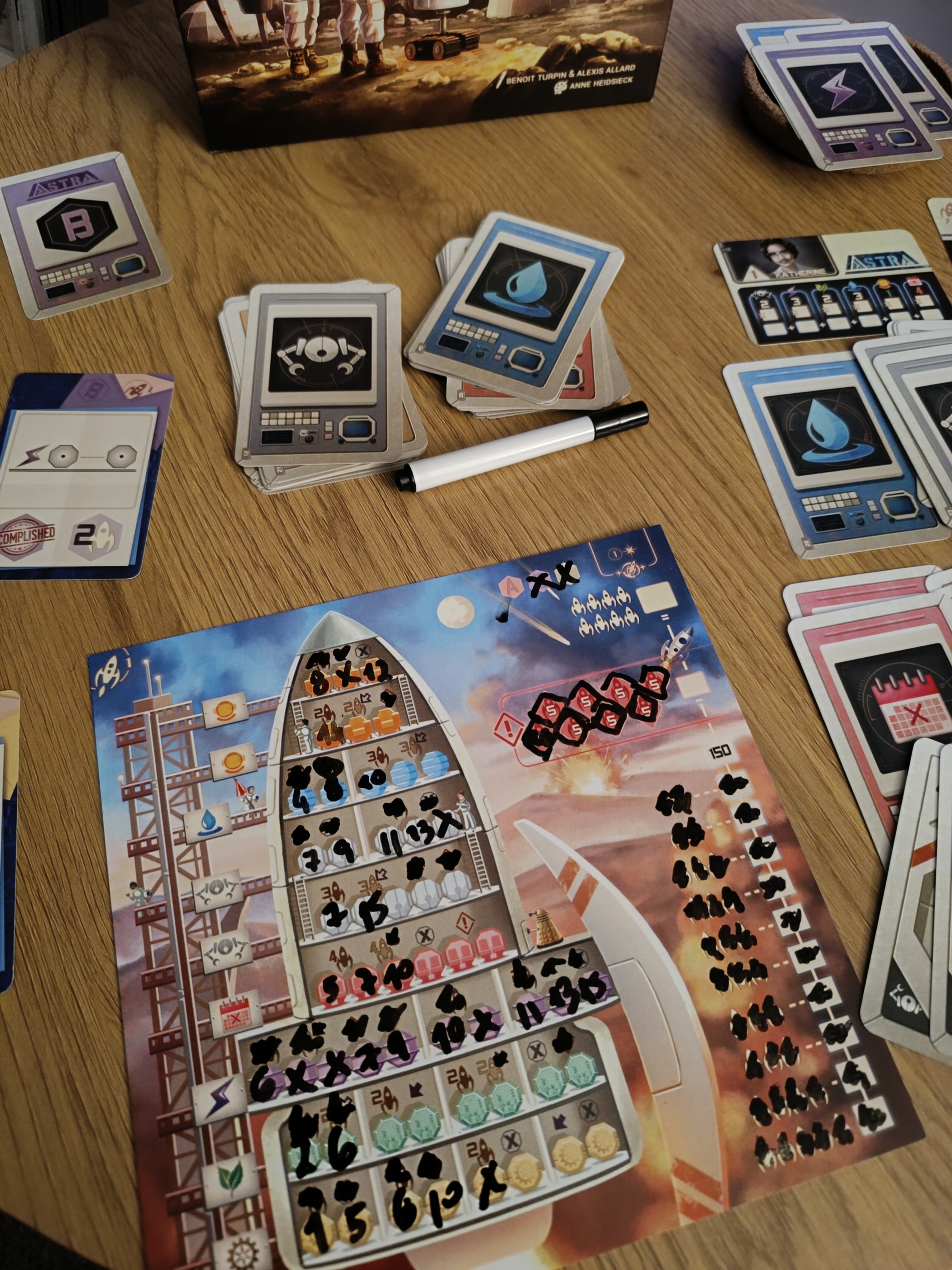
End of Adventure 1
Components
The game includes 24 double-sided sheets (6 sheets with 2 scenarios each), 6 dry-erase pencils, starship cards, achievement cards, an adventure book with flavor text and setup instructions, and solo-specific cards.
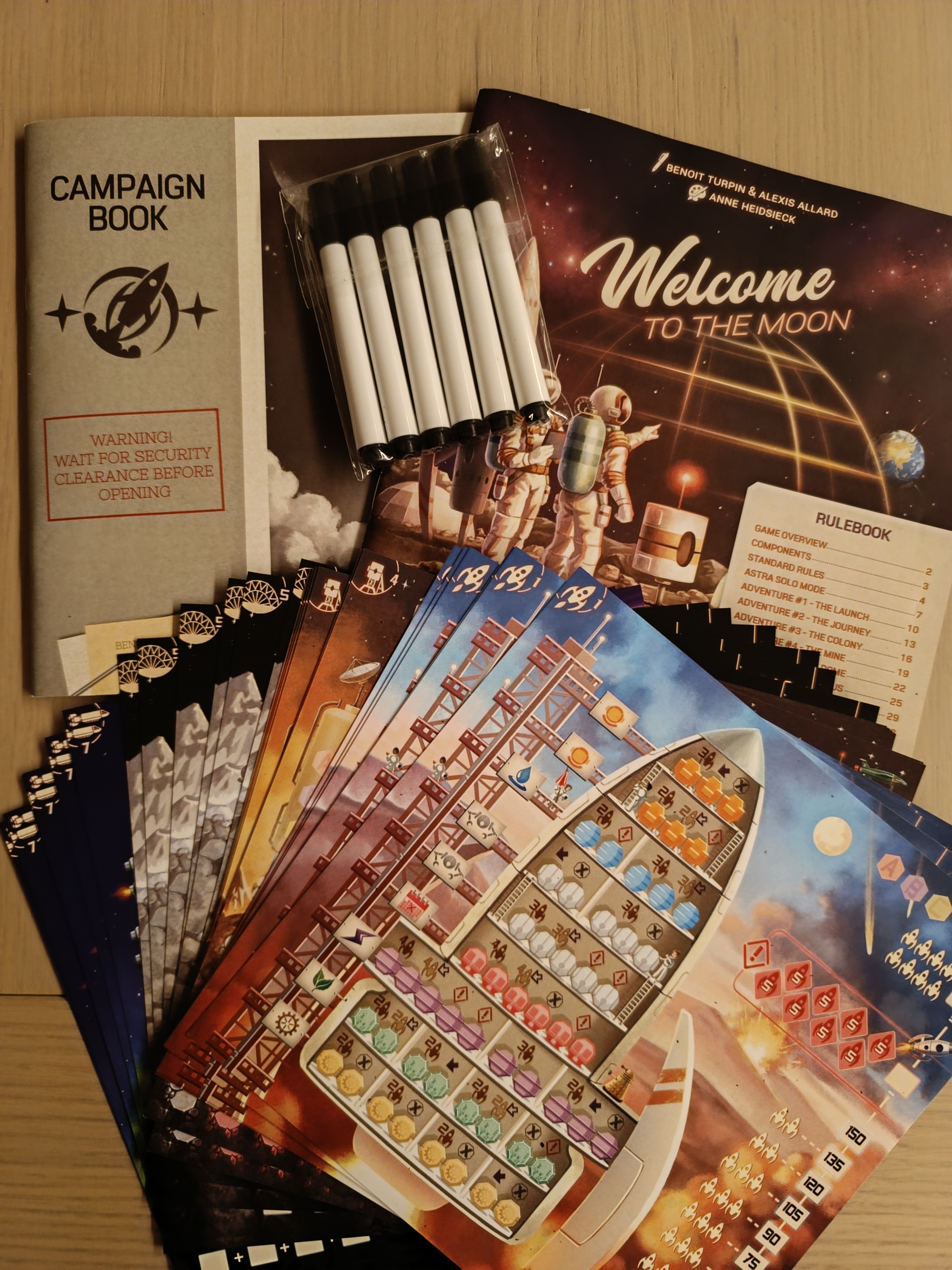
Components
Component Quality
A major plus: instead of paper pads, the game uses reusable sheets compatible with dry-erase markers. This keeps the box compact and allows unlimited replays. The internal organizers are fantastic, keeping everything well organized.
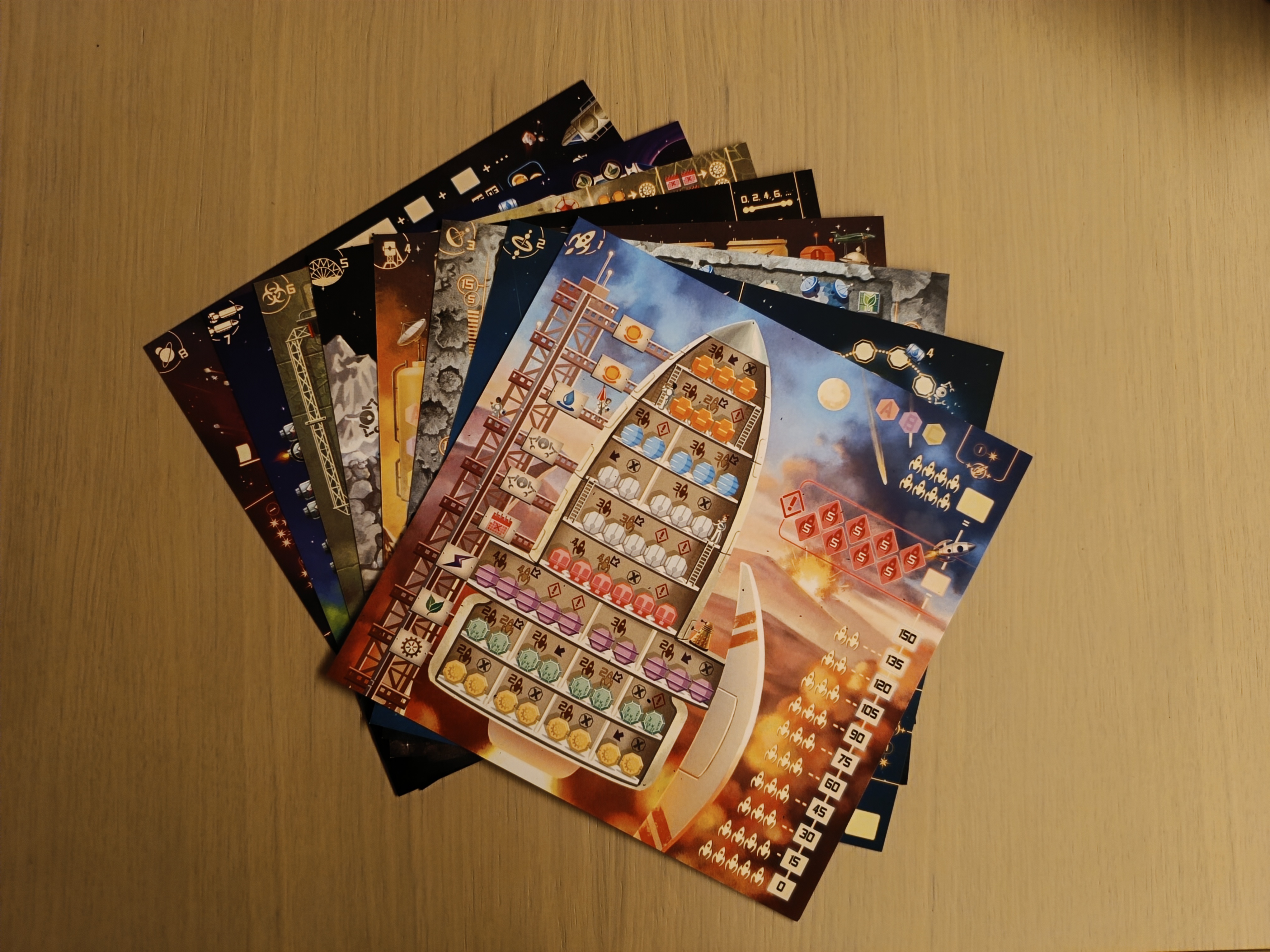
Erasable Sheets
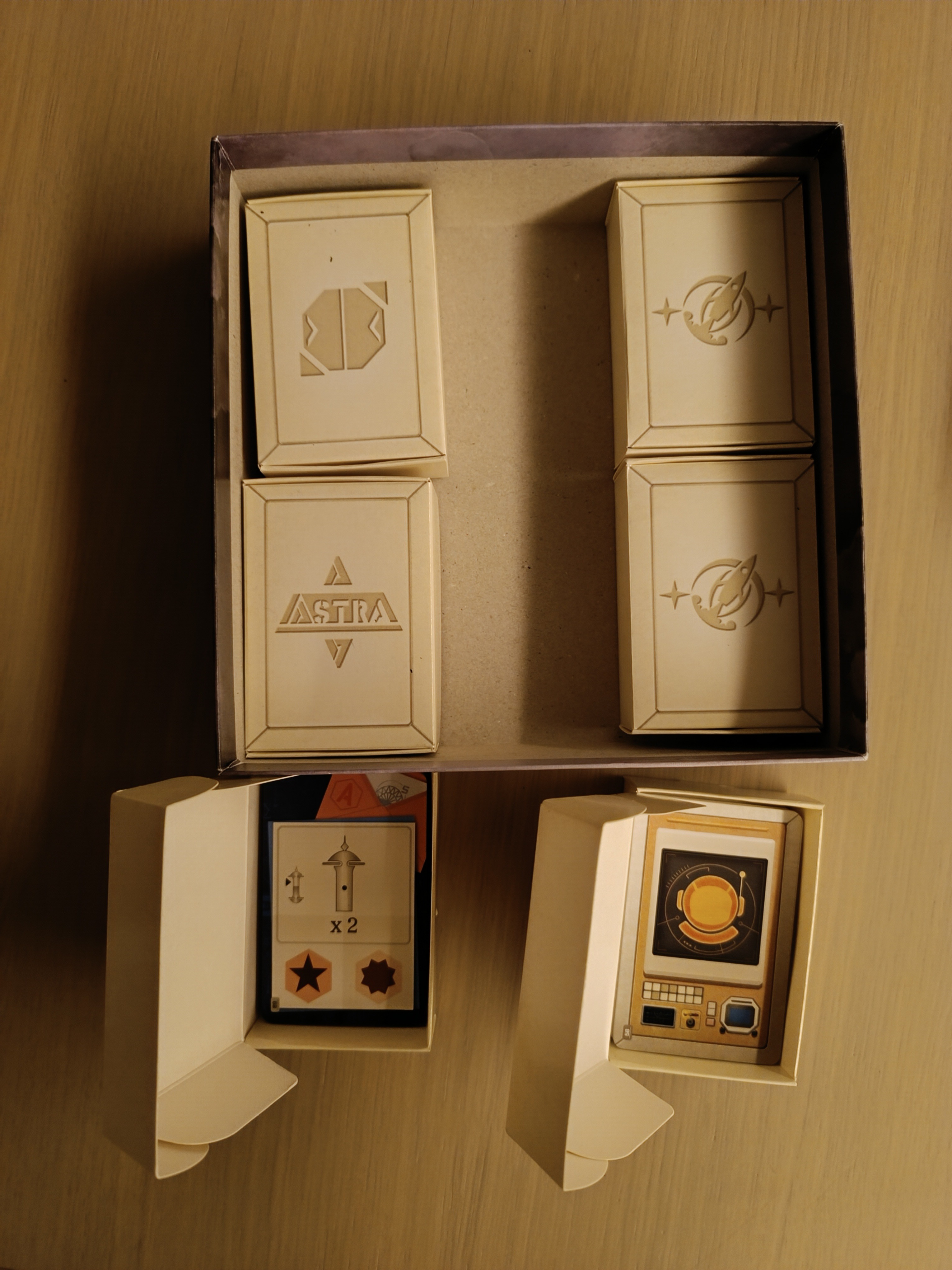
Organizers
How It Plays
Each round, you reveal cards showing number-action pairs. Choose one pair, write the number on your sheet following the adventure’s placement rules, then optionally use the action. Actions include robots for building connections, water/plants for resources, energy for boosting effects, astronauts for modifying numbers (-2 to +2), and planning for strategic crosses.
The brilliance is in the tension: which number-action combo serves your immediate needs versus long-term strategy? Do you grab the perfect number but weak action, or the action you desperately need with an awkward number? Every choice matters because you’re racing toward three objectives while avoiding system errors that could end your game prematurely.
The game continues until someone completes all 3 objectives, fills every space on their sheet, or crosses all system errors. These conditions apply to both solo and multiplayer modes.
Adventure Variety
What I’ve noticed through Adventures 1-4 is a steady increase in difficulty and the introduction of new mechanics. The theme doesn’t change but evolves beautifully, starting from ship preparation (Adventure 1), progressing through the journey to the moon, arrival, and beginning mining operations (Adventure 4).
For example, Adventure 4 introduces mining as a two-step process: first entering numbers, then extracting resources by completing columns. Each adventure builds on the previous one while adding its own twist, creating a cohesive narrative of lunar colonization. The 8 adventures together form a complete story of establishing humanity’s presence on the moon.
Campaign Mode
The campaign mode is where Welcome to the Moon truly shines. You score points at each scenario based on whether you accomplished objectives. You track your progress on a sheet included at the end of the campaign book.
I haven’t finished the campaign yet, but I’m experiencing that satisfying feeling of having more points than the automa. However, each new scenario is more complicated and offers more points for completion, so the challenge intensifies. There are branching scenarios, in the first campaign part, these determine which 3 missions appear in each adventure.
The full campaign requires at least 16 plays (8 adventures × 2 campaign parts). It’s easily replayed and simple to reset, making it perfect for multiple campaign runs or teaching new players.
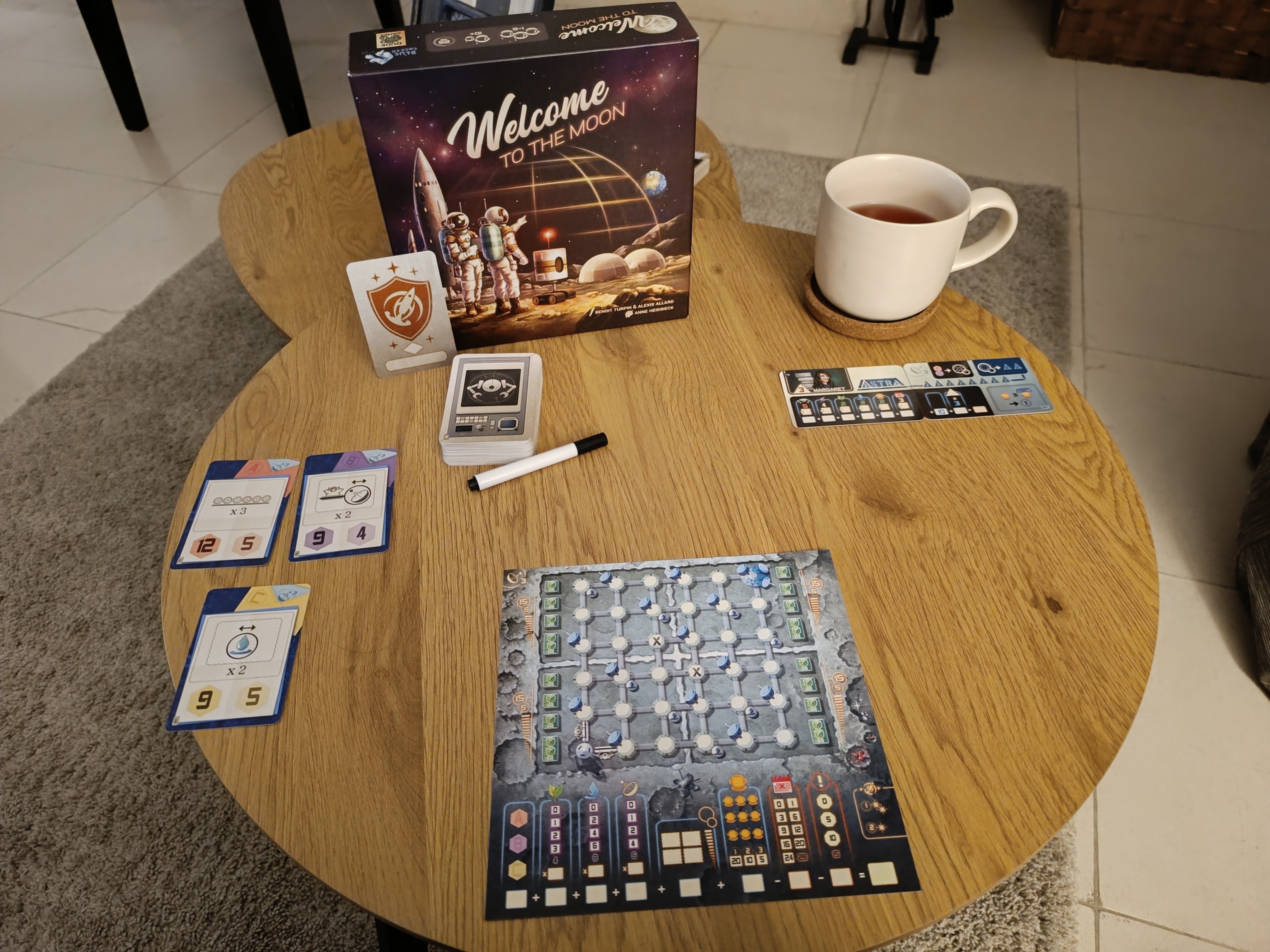
Setup for Adventure 3
Solo Mode
In solo play, you draw 3 cards from a single deck each round. Select 2 cards, one for the number, one for the action, and give the remaining card to the automa.
At game end, the automa scores by summing cards of each type and multiplying by a level-specific multiplier. When mission cards are drawn, you follow AI-specific actions (usually crossing bonuses from your board to simulate multiplayer competition).
When all cards are drawn, reshuffle the discard pile (excluding automa cards). Mission cards are shuffled into the entire deck for subsequent draws.
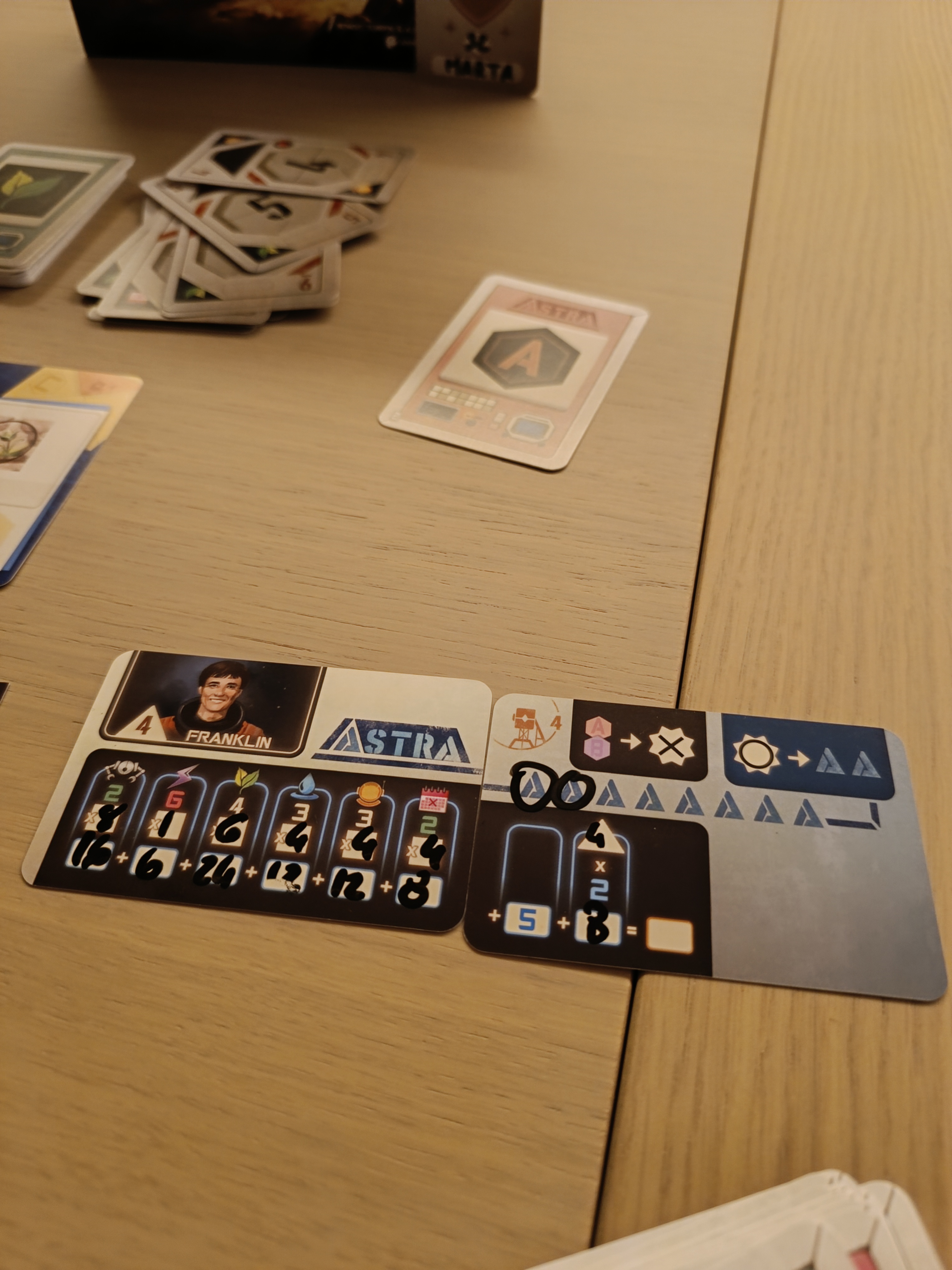
Automa Cards
Learning Curve
The rules are simple, straightforward, and require no constant rulebook reference, everything flows smoothly. I haven’t taught it to anyone yet, but I estimate 5-10 minutes would be sufficient to explain the core concepts. Each adventure’s unique rules are clearly explained and easy to grasp.
Comparison to Other Flip-and-Writes
I haven’t played the original Welcome To…, so I can’t compare directly. However, when comparing with other flip-and-writes like Demeter, Welcome to the Moon stands out as more complete due to its story dimension. The campaign structure and narrative progression elevate it beyond typical flip & write experiences.
My Experience
I’m currently playing through the campaign and just finished mission 4, mission 5 is next. I haven’t yet started the second campaign part with the hidden narrative cards, as I’m still working through the learning portion.
So far, I’ve lost only once to the AI and won 3 times. It’s been a real pleasure moving through the different adventures and reading the story. The adventures have a logical progression that makes thematic sense and keeps me eager for the next challenge.
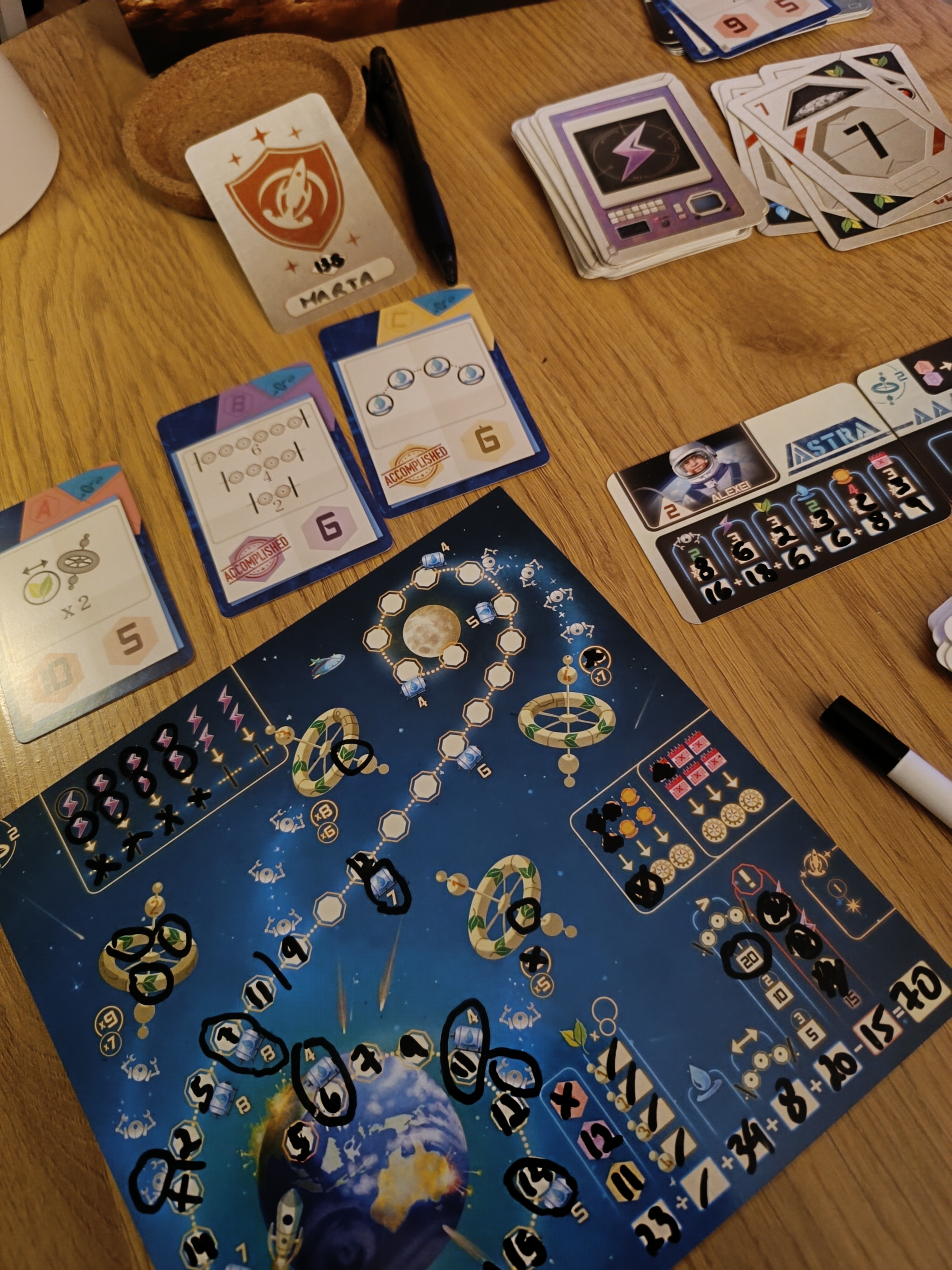
Adventure 2
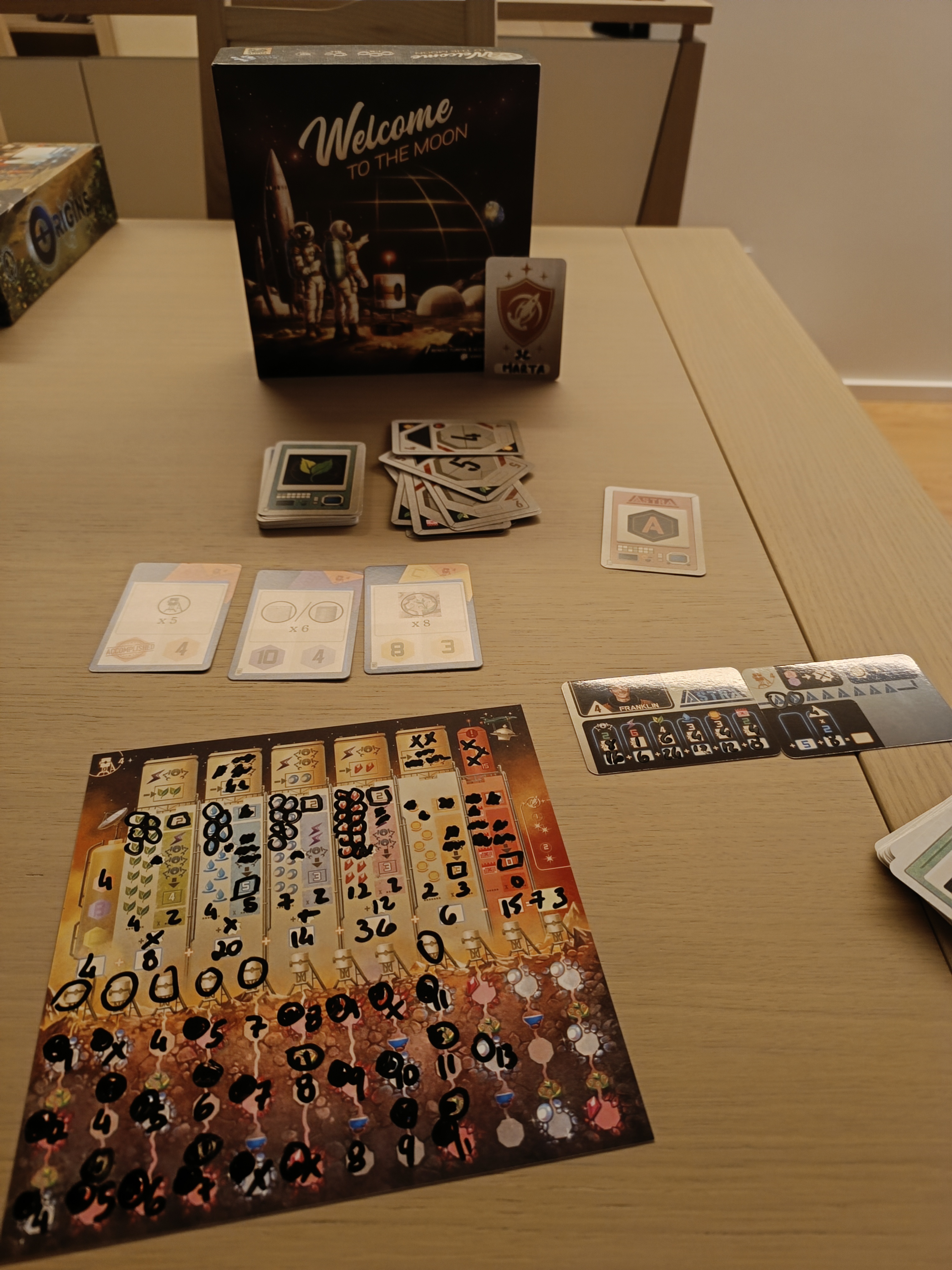
Adventure 4
Pros and Cons
What I Love:
- Excellent variability and replayability through 8 distinct adventures
- Campaign mode adds meaningful narrative progression
- Reusable sheets are environmentally friendly and space-efficient
- Simple rules that flow smoothly
- Satisfying strategic tension in every card choice
- Great organization inside the box
- Quick playtime (25-30 minutes) perfect for multiple sessions
What Holds It Back:
- While excellent, I suspect replayability will diminish after completing the campaign
- Flip & write mechanics, while well-executed here, aren’t my absolute favorite genre
- The game creates that “one more play” urge during the campaign, but I’m uncertain about long-term replay value once the story is complete
Final Thoughts
Rating: 9 out of 10
Welcome to the Moon successfully captures the excitement of lunar colonization in an accessible flip & write format. The 8 adventures provide significant variety, the campaign mode adds compelling narrative depth, and the reusable sheets are an excellent design choice.
This is probably one of my favorite flip-and-writes. It’s quick to play, easy to set up, and the campaign structure gives it staying power that most flip-and-writes lack. The steady difficulty progression and introduction of new mechanics keep each adventure fresh and challenging.
If you enjoy flip-and-writes and want one with excellent replayability, a compelling campaign, and meaningful strategic decisions, Welcome to the Moon is highly recommended. Even if flip-and-writes aren’t typically your favorite, the narrative structure and adventure variety make this worth trying.
Your Turn
Have you played Welcome to the Moon? Which adventure is your favorite? How far have you gotten in the campaign? I’d love to hear your experiences!
Related Links
Videos
- Solooperative Games - Solo playthrough of the Adventure 1