Hello everyone!
This time I’m bringing you a Roll & Write game: Troyes Dice.
Troyes Dice is a strategic dice drafting and city-building game where you compete to leave your mark on a medieval city. Despite a steep learning curve, it offers satisfying depth and good replayability through variable dice results and an optional expansion.
Game Overview
Troyes Dice is a 2020 release for 1-10 players, ages 12+, with a playtime of 20-30 minutes. It was designed by Sébastien Dujardin, Xavier Georges, and Alain Orban, illustrated by Alexandre Roche, and published by Pearl Games.
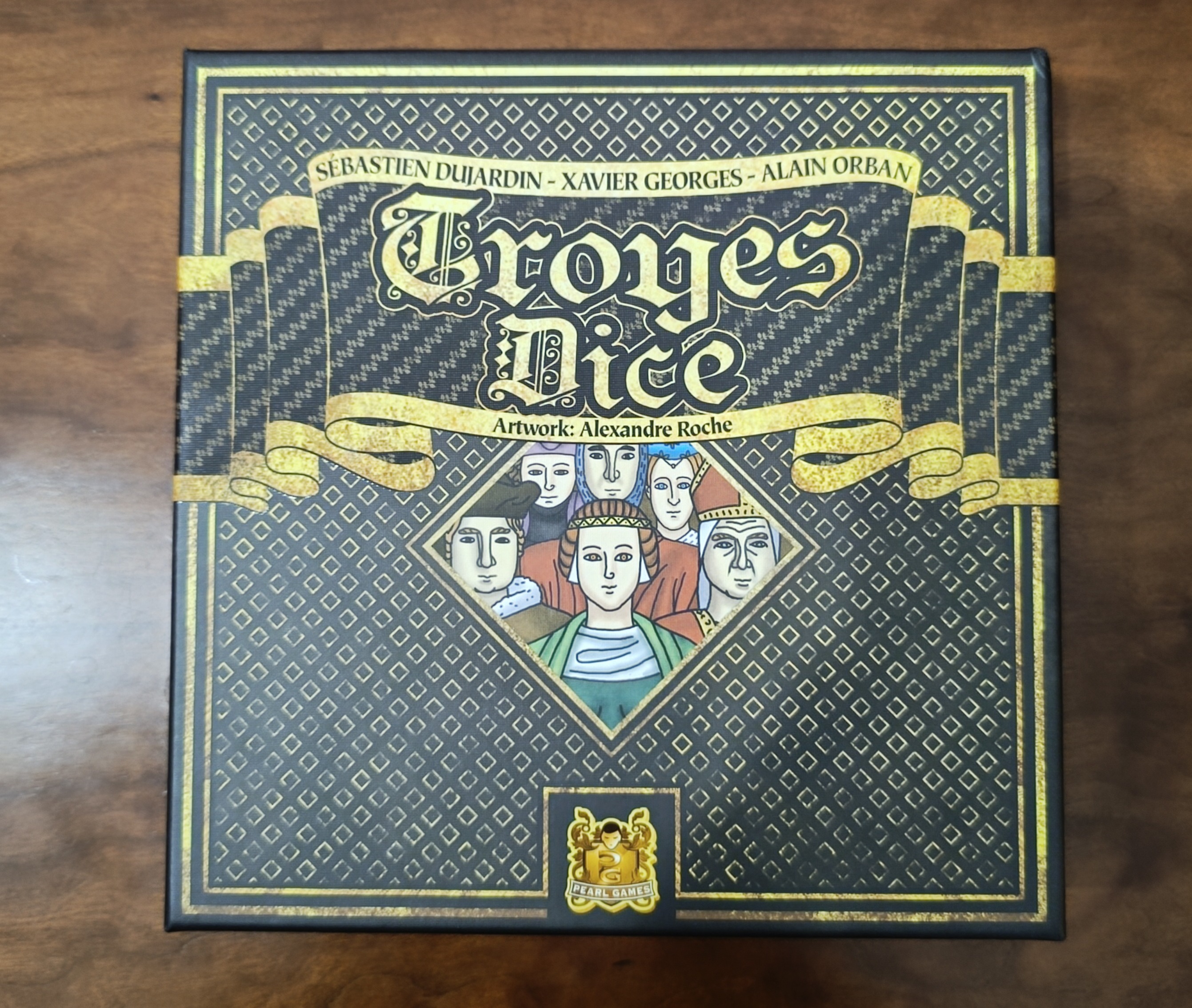
Troyes Dice box
Theme
In Troyes Dice, you represent a wealthy Champagne family working alongside the nobles, civilians, and clergy to improve the city and leave your mark on its history during the Middle Ages.
Each social order has its responsibility: nobles protect the land and ensure justice, civilians provide the hard work necessary to supply food and goods essential to city life, and clergy ensure spiritual awakening and cultural development.
How to Win
You score points by constructing fortresses to protect the city, cathedrals to improve culture, and markets for commerce. You’ll also participate in constructing prestigious buildings linked to each social order. Through construction, you’ll gain knowledge, money, and influence, which will bring more people to your city.
Your final score combines points from constructions, resources, and the population of your city. The player with the highest score wins.
The solo mode works as a Beat Your Own Score (BYOS), where you try to improve with each game.
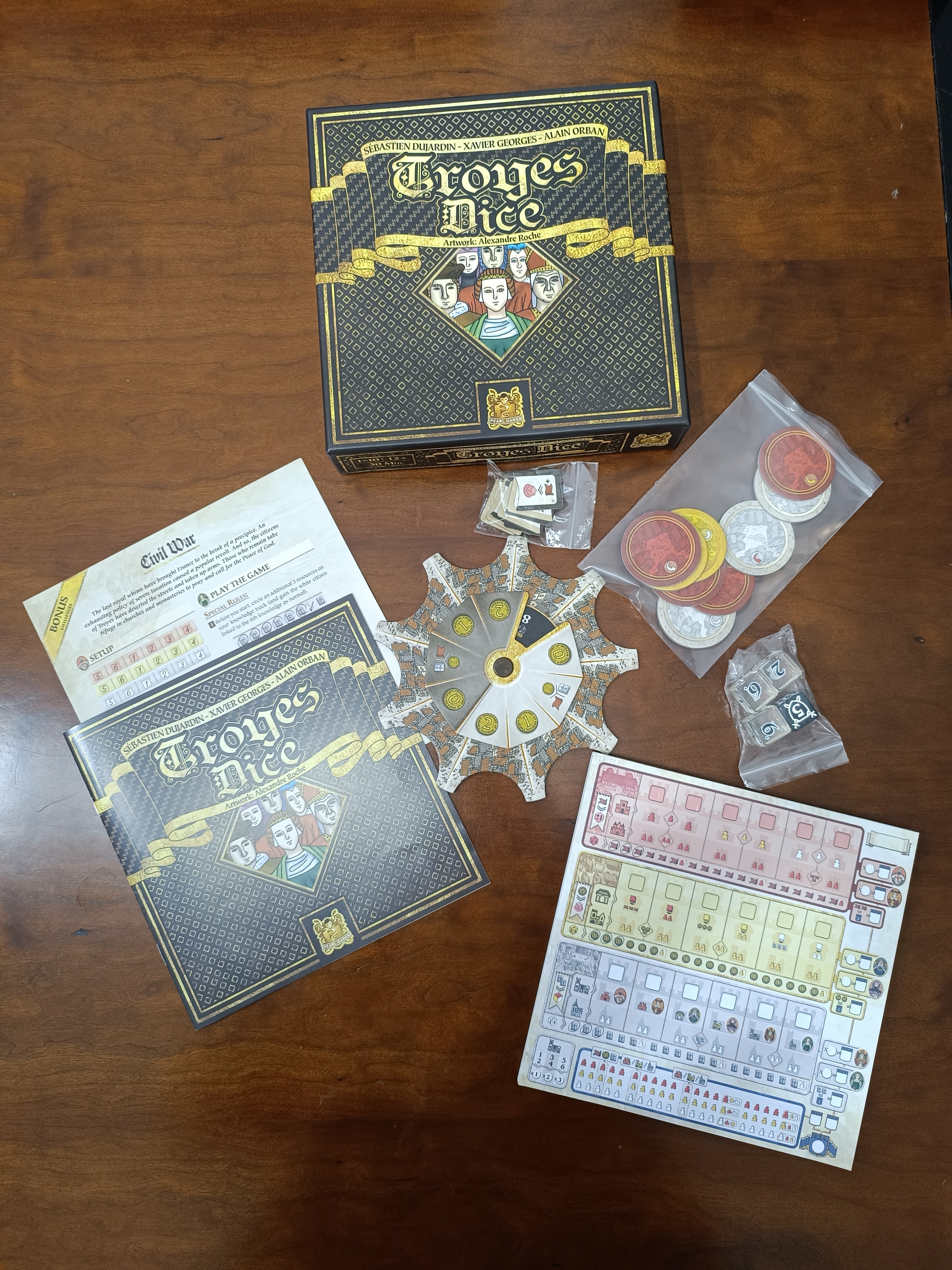
Troyes Dice components
Setup
To set up the game, place the game board at the center of the table and turn the wheel’s small layer to show day 1. Place the 9 Plaza tiles randomly around the board, flipped to a random side. Select one player to be the dice master. Each player takes a scoresheet and pencil.
For your first play, number each district 1 to 6 from left to right. In future plays, you can determine the first number by rolling a die.
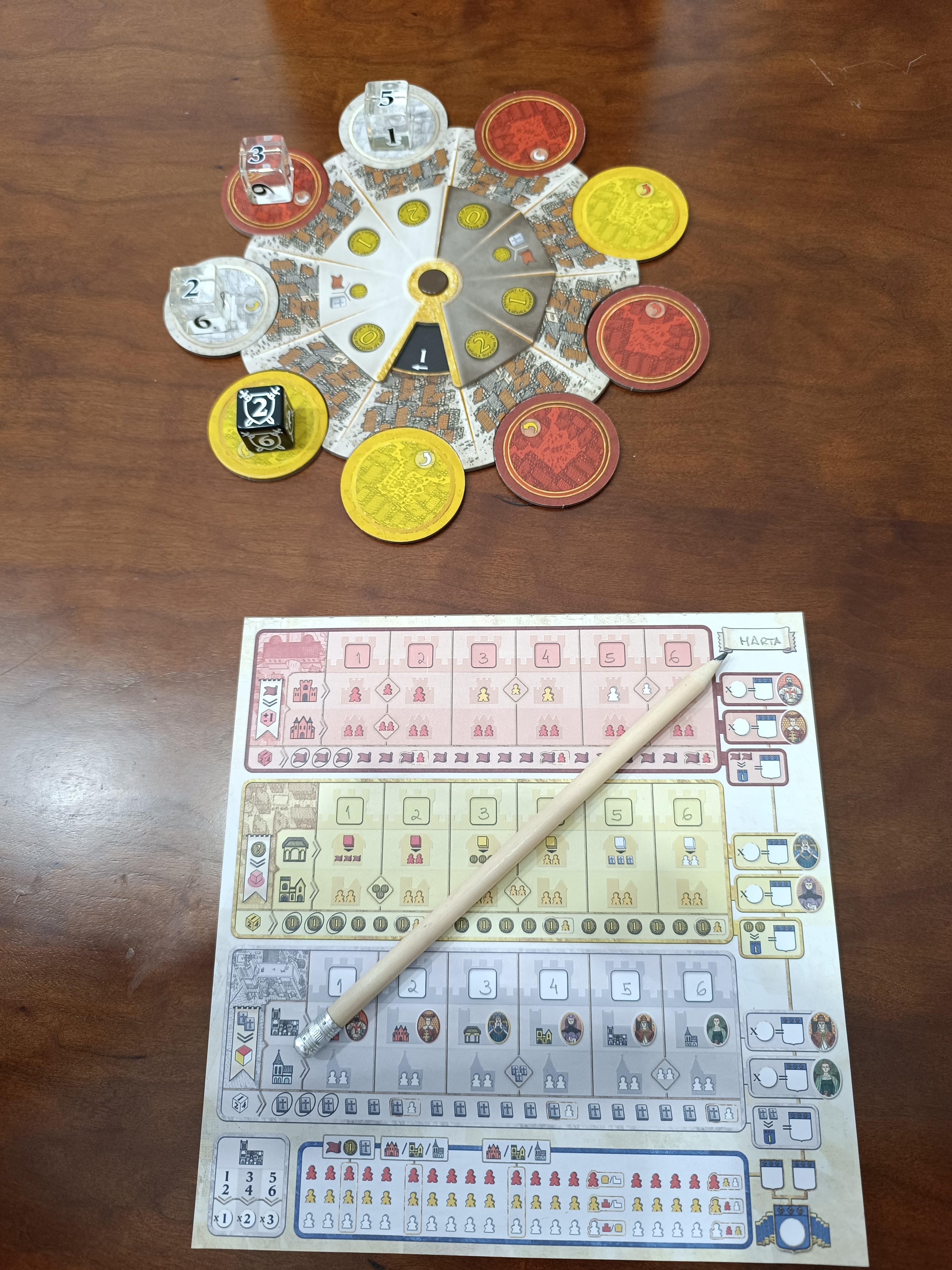
Setup for one player
Gameplay
The game consists of 16 rounds, 8 day phases and 8 night phases. Each round represents one phase and is split between morning and night. The day/night wheel simply tracks these 16 rounds. During each phase, the dice master shakes the dice and places them on the Plazas in ascending order. Day plazas are on the white side of the board wheel, and night plazas are on the black side.
If there’s a tie between the black die and another die, the black die comes first.
The dice master role remains the same player throughout the game according to the rulebook, though gaming groups can decide to rotate if they prefer, but won’t impact gameplay.
The Black Die – Attacks and Destruction
The black die represents attacks on the Plaza where it’s placed, making that Plaza unavailable. From day 3 onward, the black die also destroys the Plaza. When a Plaza is destroyed, you must cross out all related buildings (not yet used) that match both the die number (district) and the Plaza color on your scoresheet. The Plaza is then flipped to its other side for the next round, changing its color. Note that 3 Plazas have the same color on both sides.
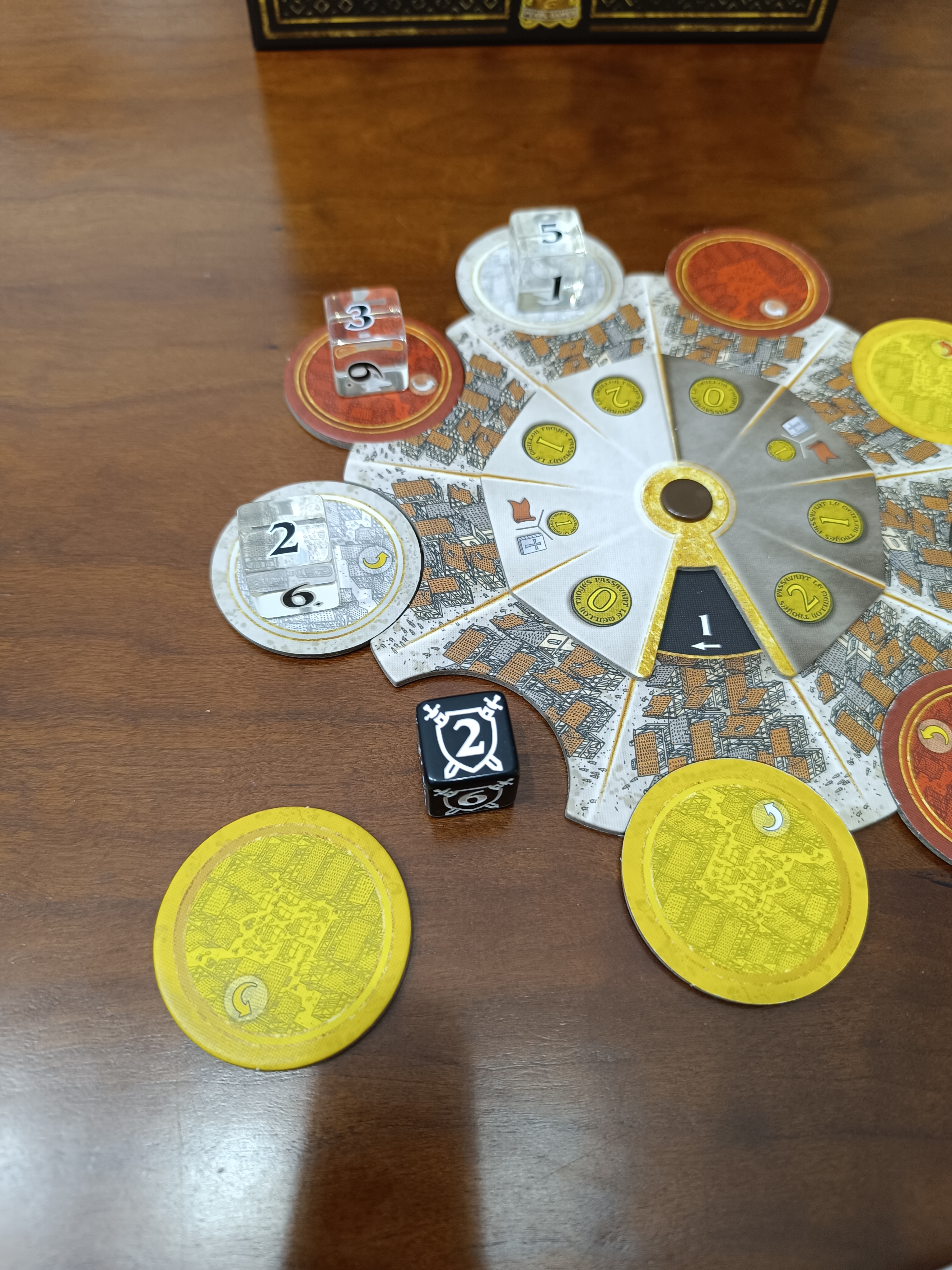
Black die effect
Scoresheet
The scoresheet is divided into 3 districts related to nobles, civilians, and clergy, each composed of 2 different buildings: nobles construct fortresses and gain influence (this protects buildings from the die number associated with that district), civilians create markets that allow you to gather money, and clergy build cathedrals that bring knowledge (each cathedral is linked to a building, and construction allows those buildings to score at game’s end).
At the bottom of the scoresheet is the Civil track. When constructing buildings, you bring people to your city. Each citizen gives you 1 point at the end of the game.
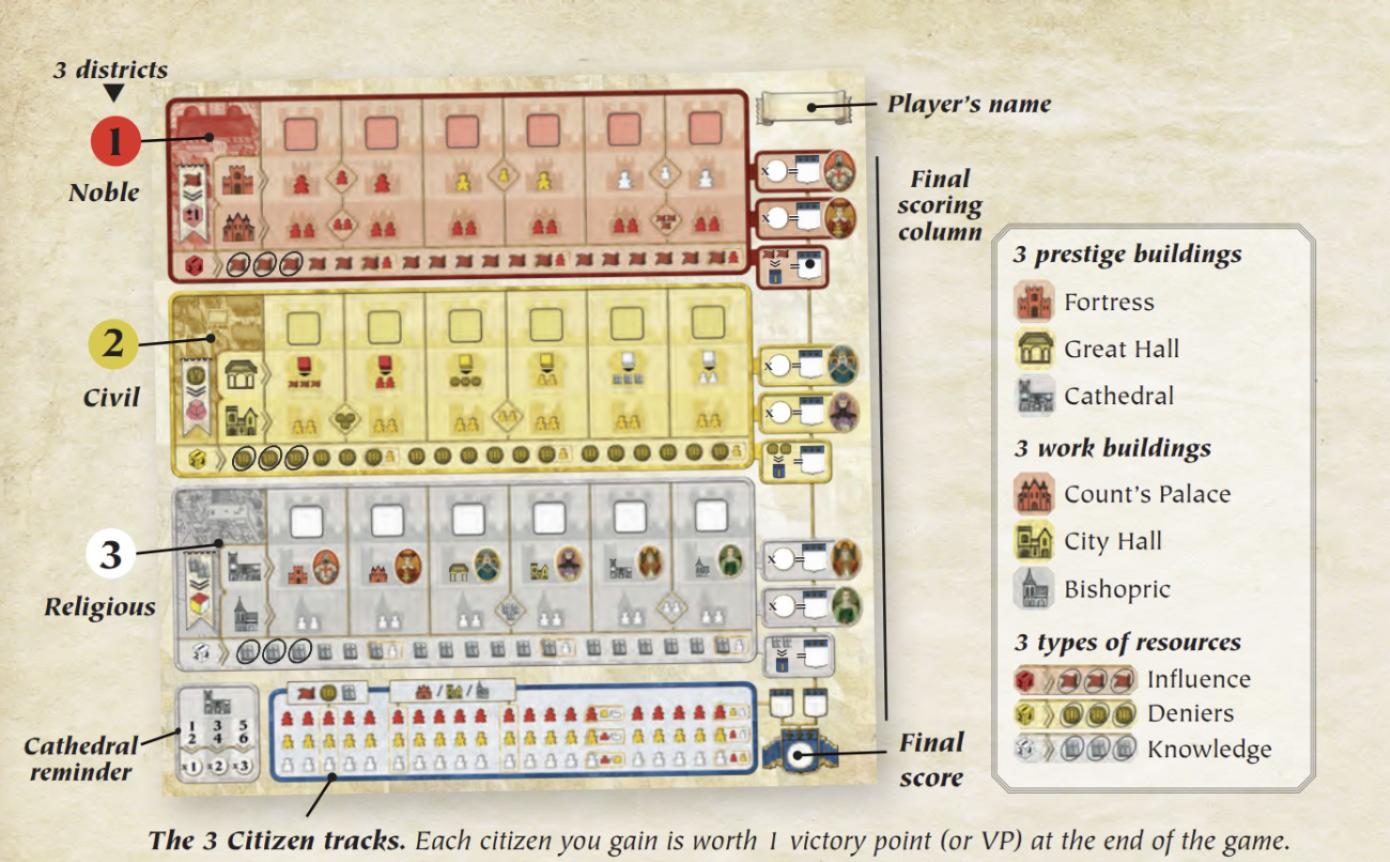
Scoresheet example showing the building tracks and resources. Image credit: Pearl Games rulebook
Selecting and Constructing
After the dice are placed each round, you select one Plaza with a transparent (colored) die. The transparent die’s color matches the Plaza color. Depending on which Plaza you select, there’s a cost to pay. You can manipulate the color or number of the die by spending knowledge or influence.
Component Quality
The scoresheets have good paper quality, but there’s one drawback: they’re only printed on one side, which feels wasteful. The dice are big and satisfying to shake, but the numbers on the transparent dice are painted rather than engraved. This could lead to the numbers wearing off over time with repeated use.
Replayability
The game has good replayability since the dice never follow the same pattern, requiring constant adaptation.
Expansion
The game includes a small expansion in the box called Banquets and Raiders that attaches effects to Plazas with the same color on both sides. These effects are positive until the Plaza is destroyed for the first time. After destruction, the effect becomes negative for the rest of the game, but you can still select dice from those Plazas.
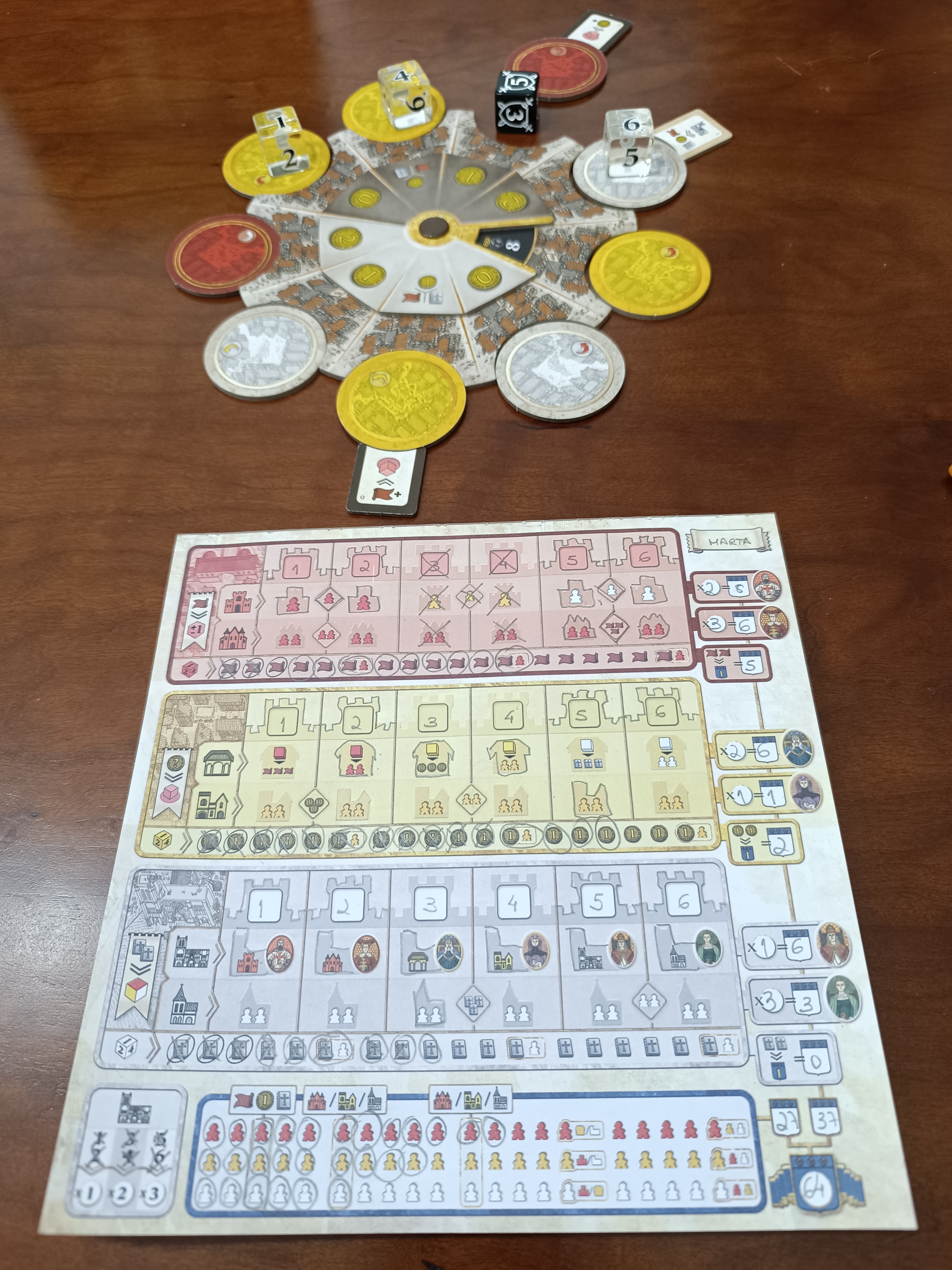
Expansion end game example
A Combo Example
When playing with the expansion, I used a die from a Plaza that allowed me to gain one influence, one coin, and one knowledge by constructing a specific building type. By doing so, I activated a bonus on one of the tracks that provided me with one more civilian. That civilian completed a bonus on the civil track, which allowed me to construct another building. These cascading effects are incredibly satisfying!
Challenges
The game also includes challenges where you face the game creators by comparing scores. Each challenge has specific instructions provided.
My Experience
I’ve played 4 times so far, and my scores have been 50, 46, 56, and 64. The progression shows the learning curve in action, after an initial dip, I’ve been steadily improving as I understand the strategies better.
Strategy Tips for Beginners
My advice: start by constructing fortresses whenever possible. They’ll help protect your districts after round 3, preventing destruction from the black die. Also, make good use of dice modifiers (knowledge and influence) to create combos, they’re key to higher scores.
Comparison with Other Roll & Writes
I’ve played several Roll & Write games like Trek 12 and Penny Papers. Troyes Dice has a completely different mechanic with its transparent dice and board game integration. I preferred Troyes Dice over Penny Papers.
When compared with Trek 12, the sensations are similar even though the mechanics are different. Troyes Dice focuses on plaza dice placement, while Trek 12 emphasizes mathematical thinking to scale the mountain. Both offer satisfying strategic depth.
Player Count
I’ve only played solo so far, so I can’t comment on multiplayer experience. However, based on the mechanics, the game has no player interaction, so the feeling should be similar at any player count. The main difference in multiplayer would be the challenge of competing for the best score.
Language Dependency
The game has no language dependency. There’s no text on the components, only the rulebook requires translation. The rules are available on the publisher’s website, making it accessible to players of any language.
My Rating
Rating: 8 out of 10
It’s a really good Roll & Write with a solid learning curve. At the beginning, I was completely lost, not knowing which dice to select or what to do. After my fourth play, I have strategies and feel much more confident. My improving scores show the rewarding progression.
I’ve tested the expansion and enjoyed it a lot. The cascading combos make the game even more satisfying. I haven’t tested the challenges yet, but I’m sure I’ll enjoy them.
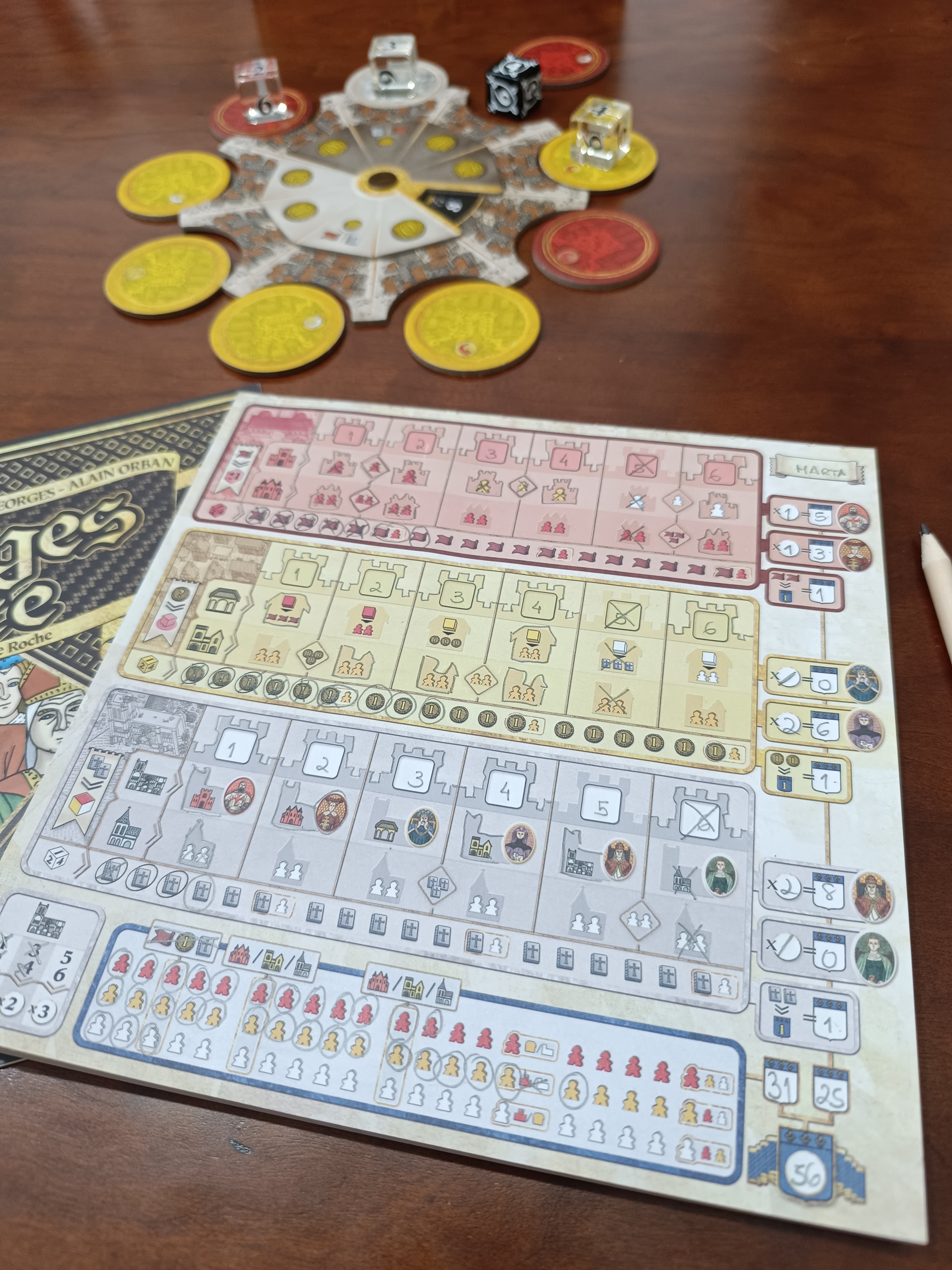
End game example
Final Thoughts
Troyes Dice is a satisfying Roll & Write that rewards strategic thinking and planning. While the first game can feel overwhelming, the learning curve is rewarding, and each game feels different thanks to dice variability. The expansion adds even more depth without adding much complexity.
The component quality has some minor issues (single-sided scoresheets, painted dice numbers), but these don’t significantly impact the gameplay experience.
If you enjoy Roll & Write games with meaningful decisions and don’t mind a bit of initial confusion, Troyes Dice is definitely worth trying.
Your Turn
Have you played Troyes Dice? How many plays did it take you to feel comfortable with the strategy? Have you tried the expansion? What’s your highest score?