Hello everyone!
Today I’m sharing my thoughts on Underwater Cities. It’s a card-driven worker placement game about building underwater civilizations. Despite some material quality issues, I really enjoyed this game and immediately wanted to play again after each session.
Game Overview
Underwater Cities is a 2018 release for 1–4 players, ages 12+, with a playtime of 80–150 minutes. It was designed by Vladimír Suchý, illustrated by Milan Vavroň and Uildrim, and published by Delicious Games.
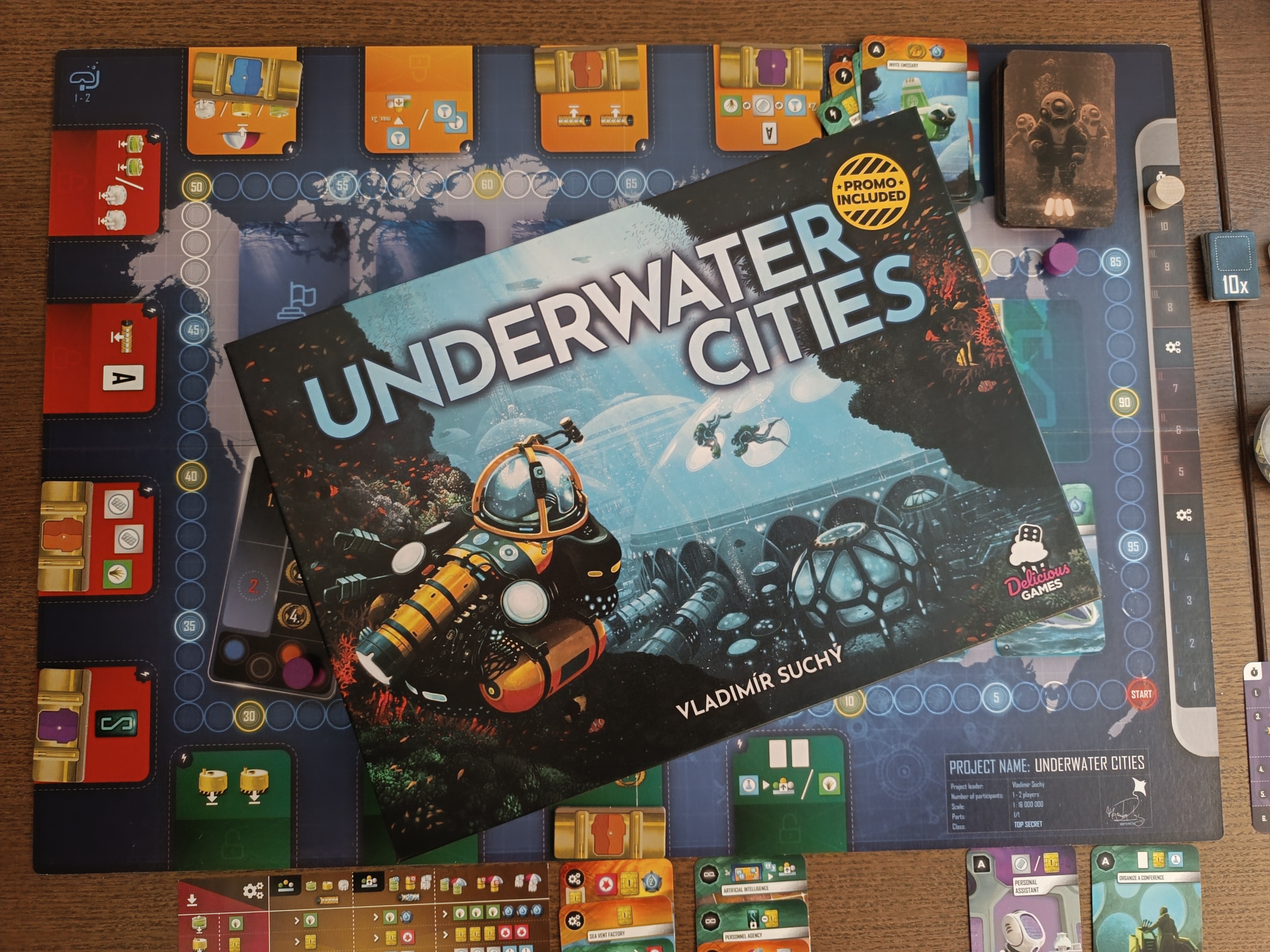
Underwater Cities box
Theme
In Underwater Cities, players represent the world’s brightest minds, selected by the population to help humanity expand. Earth is overpopulated and we’re still four decades away from colonizing Mars (still trying to Terraform Mars in another board game 😝). With humanity’s rapid growth, underwater cities are the only way to expand our territory and accommodate everyone.
You’ll construct symbiotic cities and facilities to produce food and desalinate water, while creating laboratories to develop new technologies.
How to Win
Victory goes to whoever scores the most points. While you earn some points throughout the game via direct actions and production phases, the bulk of your score comes from end-game scoring with your cities, end-game scoring cards and tiles, plus remaining materials and money.
Setup & Components
There’s no insert in the box, meaning lots of plastic bags to store everything. This makes setup slow for a game that, with a proper insert, would take 5–8 minutes to set up. It’s an excellent candidate for creating my own origami insert! 😝
The material quality is disappointing compared to the gameplay quality. The tokens are poor-quality cardboard, and the player board is a thin sheet of paper. This game deserves better.
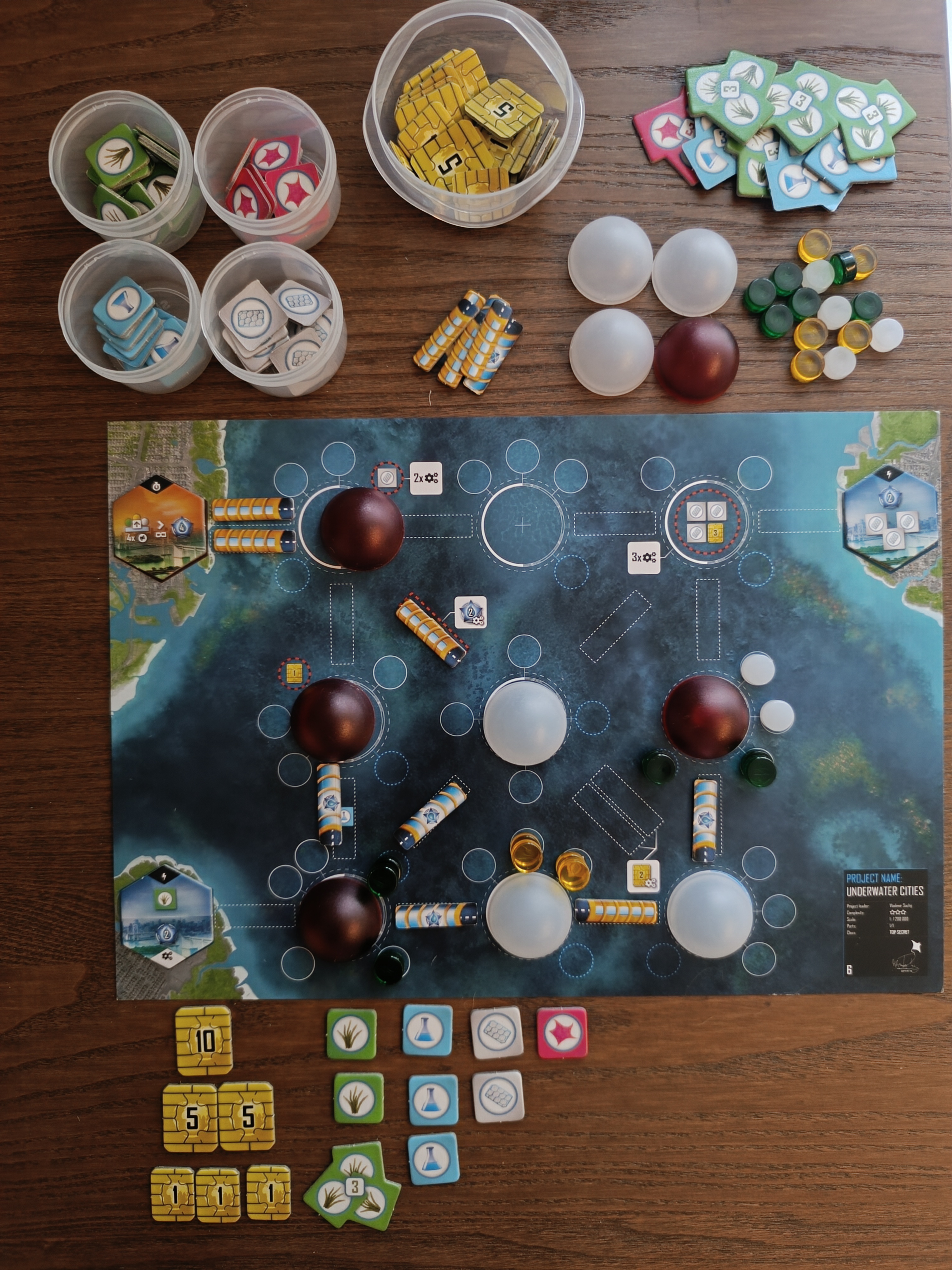
Resources
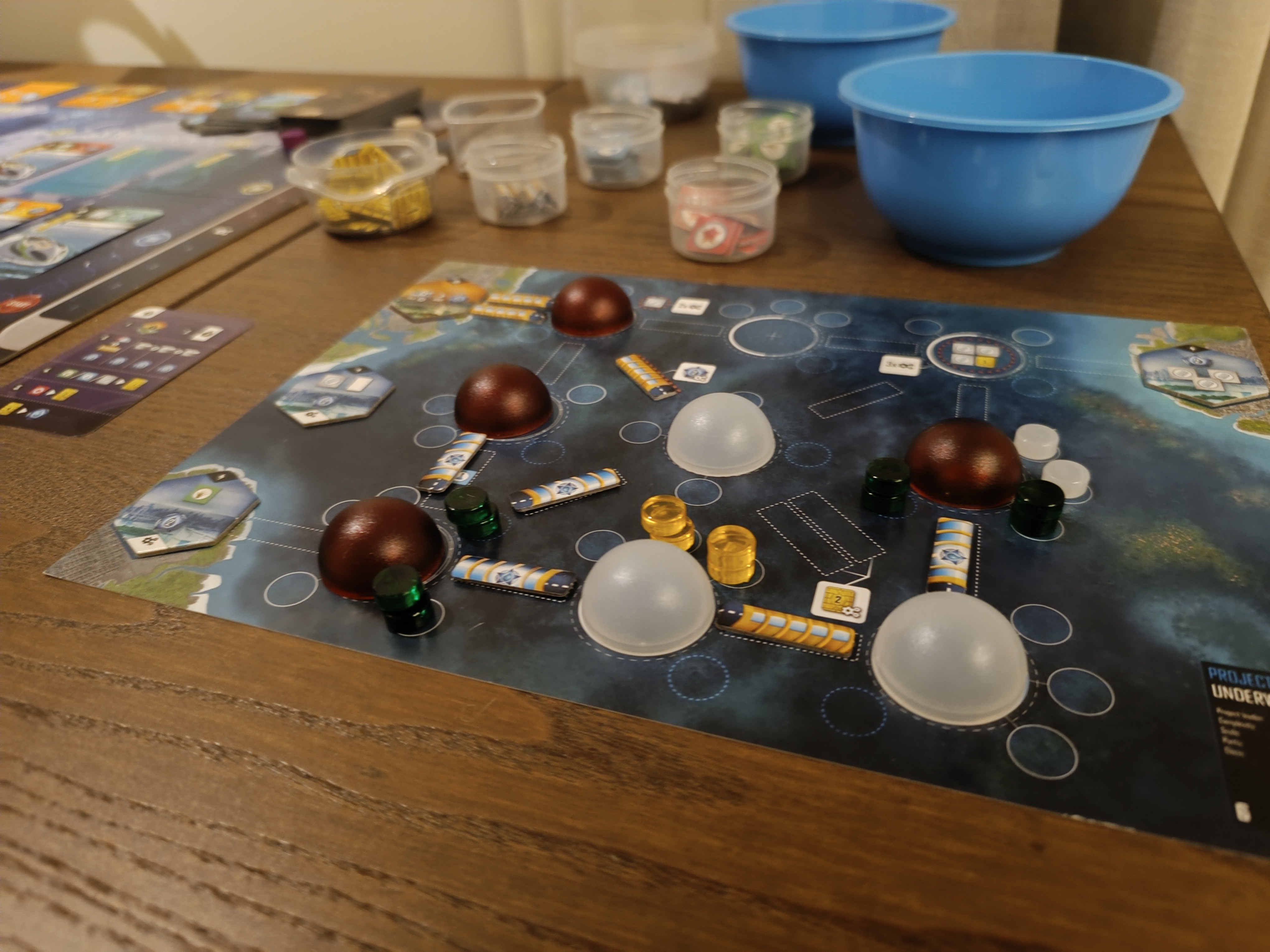
Player Board
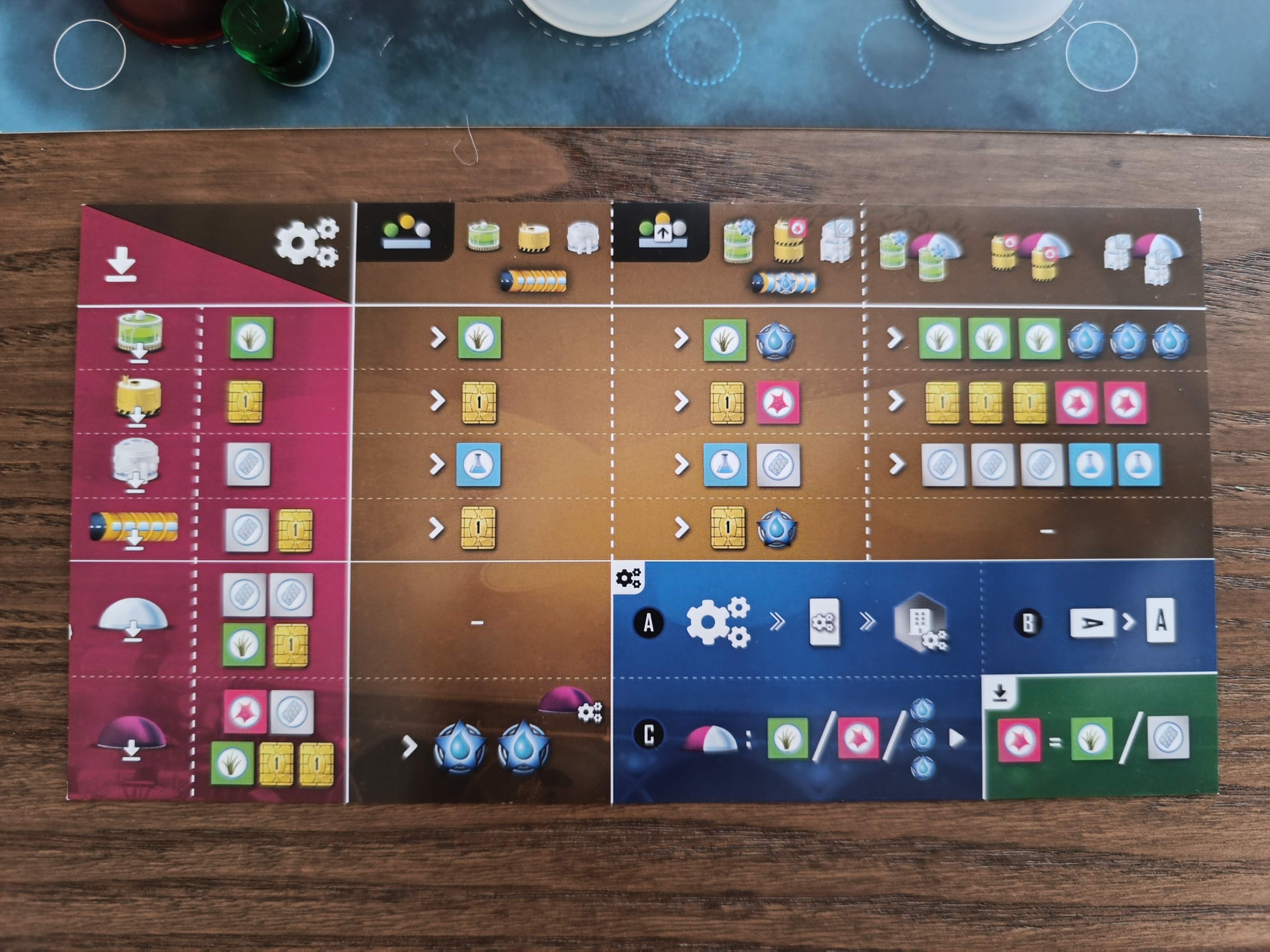
Player Aid
Gameplay
The game is essentially card placement based, divided into 3 eras with 3–4 rounds each. Each round, you perform 3 actions by placing a token in an available spot on the board, triggering an immediate action. There are 3 different action zones, each color-coded.
When selecting an action, you must also play a card. If the colors match, you can execute the card’s action; otherwise, the card is discarded. For instance, if you place your token on a green action space and play a green card, you get both the board action AND the card effect.
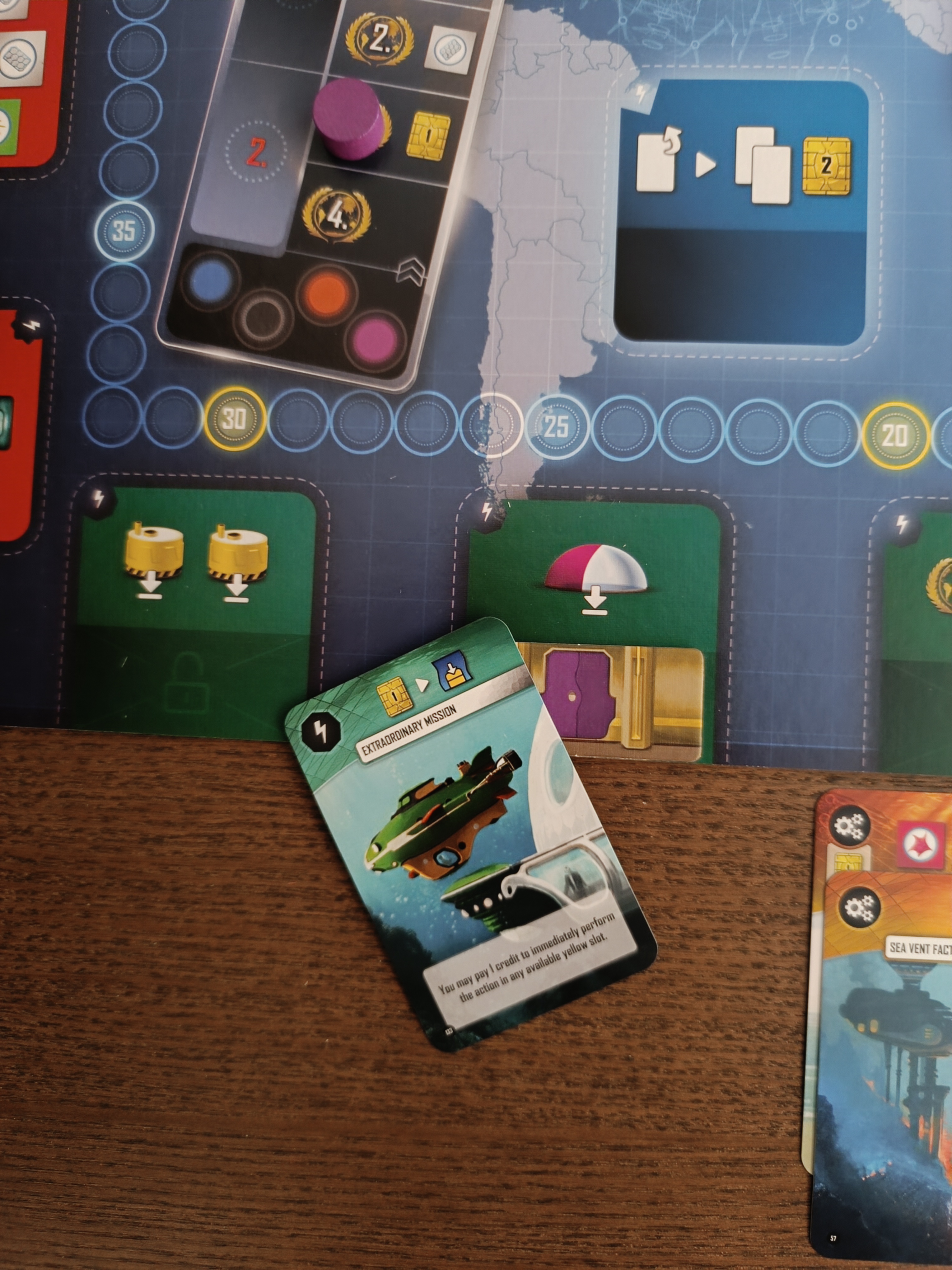
Action example: Purple player blocks the actions with his token and plays a card. The player will be able to build a symbiotic city and resolve the effect of the card.
Card Types
There are 5 different card types: immediate effect cards, permanent effect cards, cards with effects activated once per era when triggered on the board, production cards that activate at each era’s end, and end-game scoring cards.
Additionally, there are special cards that can include any of the above types but have a cost to play and offer more powerful effects.
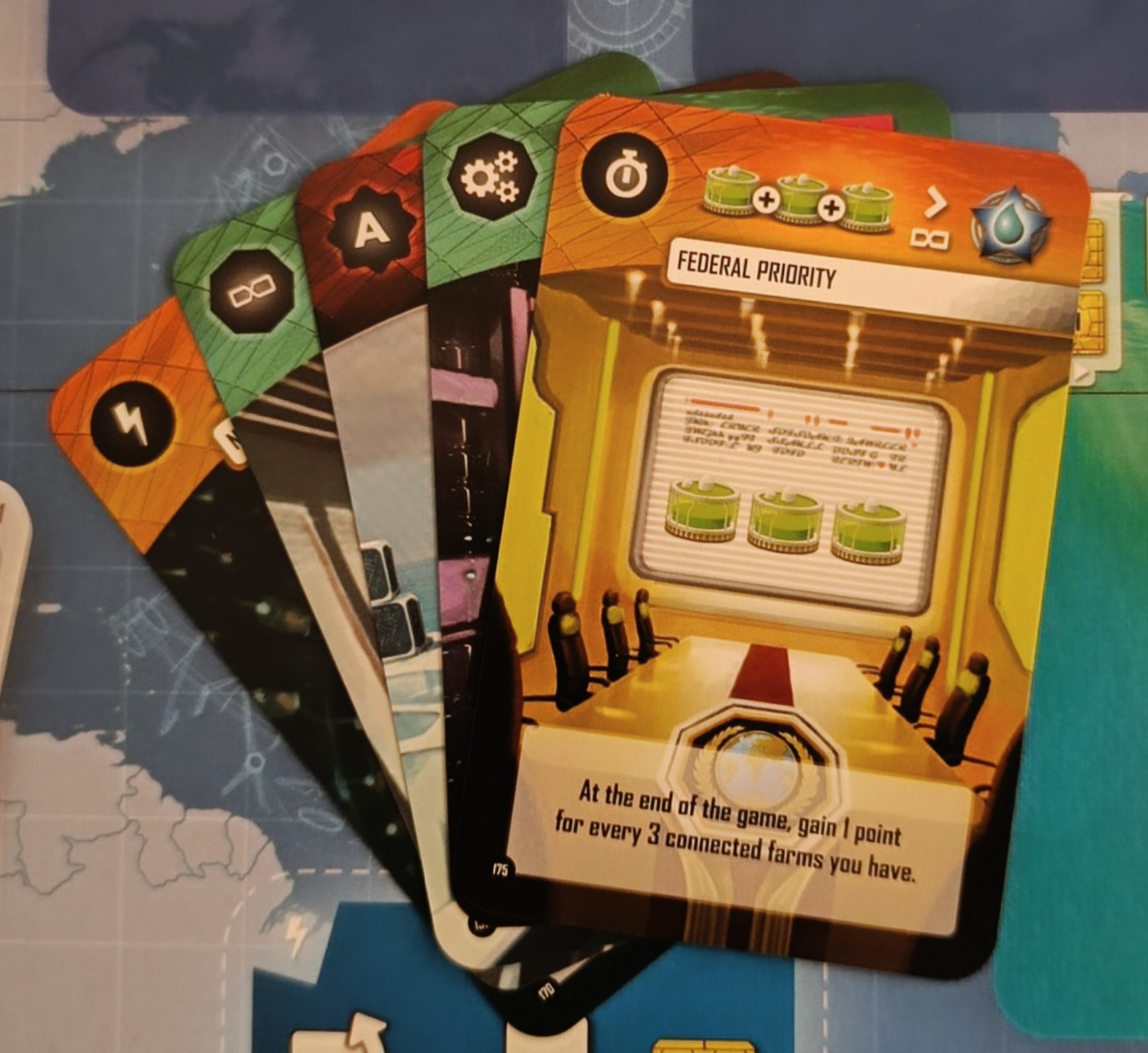
Different types of cards
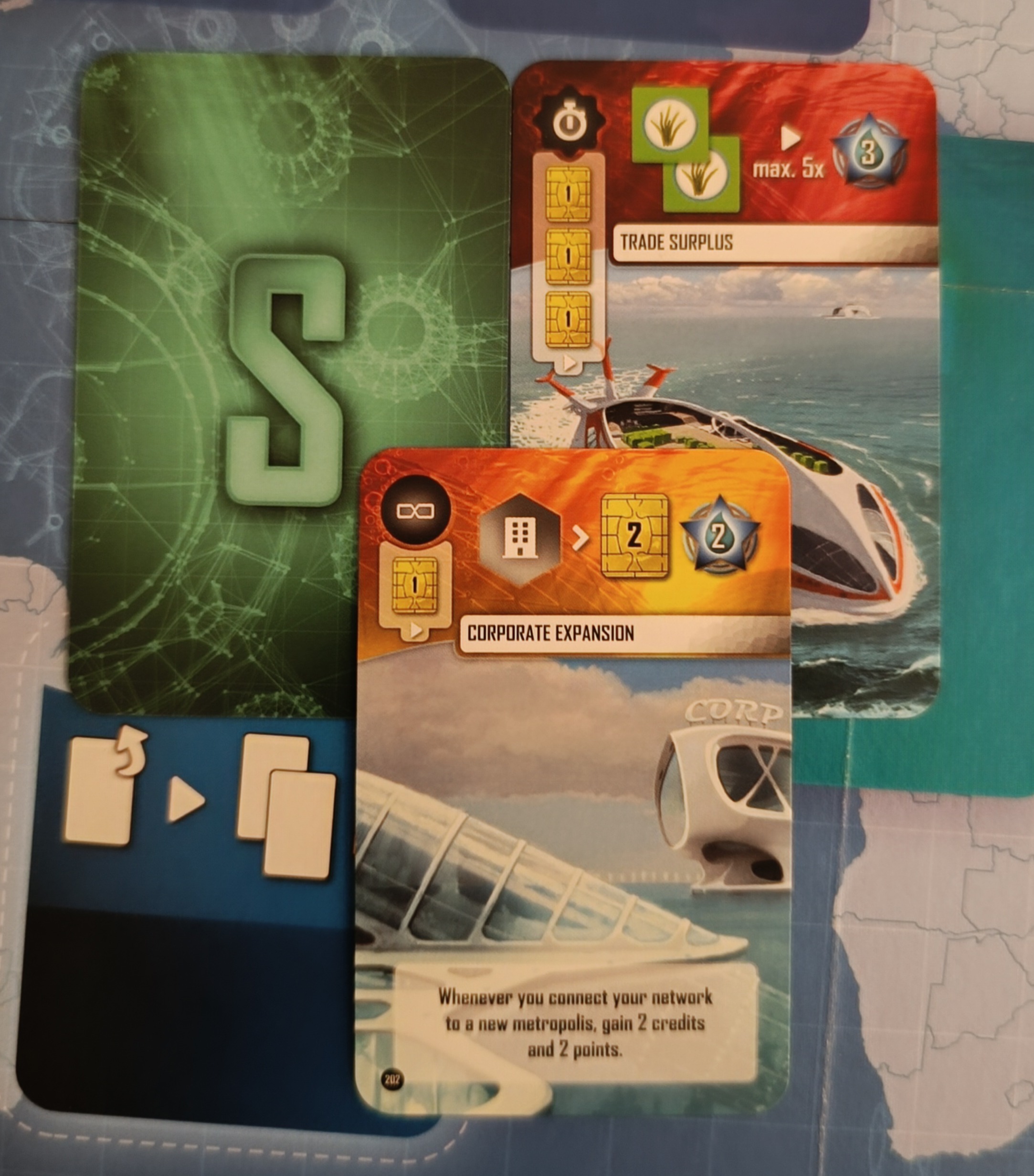
Special cards with card back and cost
Throughout the rounds, you’ll develop your cities by creating symbiotic cities (domes) and plants attached to those domes. Cities only become productive and count toward your network once connecting tunnels are built.
Strategic Combos
The game allows for satisfying combos. For example, you might have played an ongoing effect card that allows you to gain credits every time you upgrade a tunnel. Or you can play an action in the green zone that activates that specific action, and with the card effect, you can pay a credit to activate another action from a different zone. These combinations create powerful turns when properly planned.
My Opinion
The solo game is a kind of BYOS. There’s no real automa, just a system that blocks your actions in a fixed pattern each round. To win, you need 7 connected cities and a score of 100 points or more.
I’m not usually a huge fan of BYOS games, but this one didn’t bother me. The game has a Terraforming Mars feel with its cards, tableau building, and combos.
I’ve played twice so far, and I can already say the game is frustrating in the best way possible. I’ve lost both times, but instead of feeling defeated, I immediately want to play again. As soon as the game ends, I want to start over.
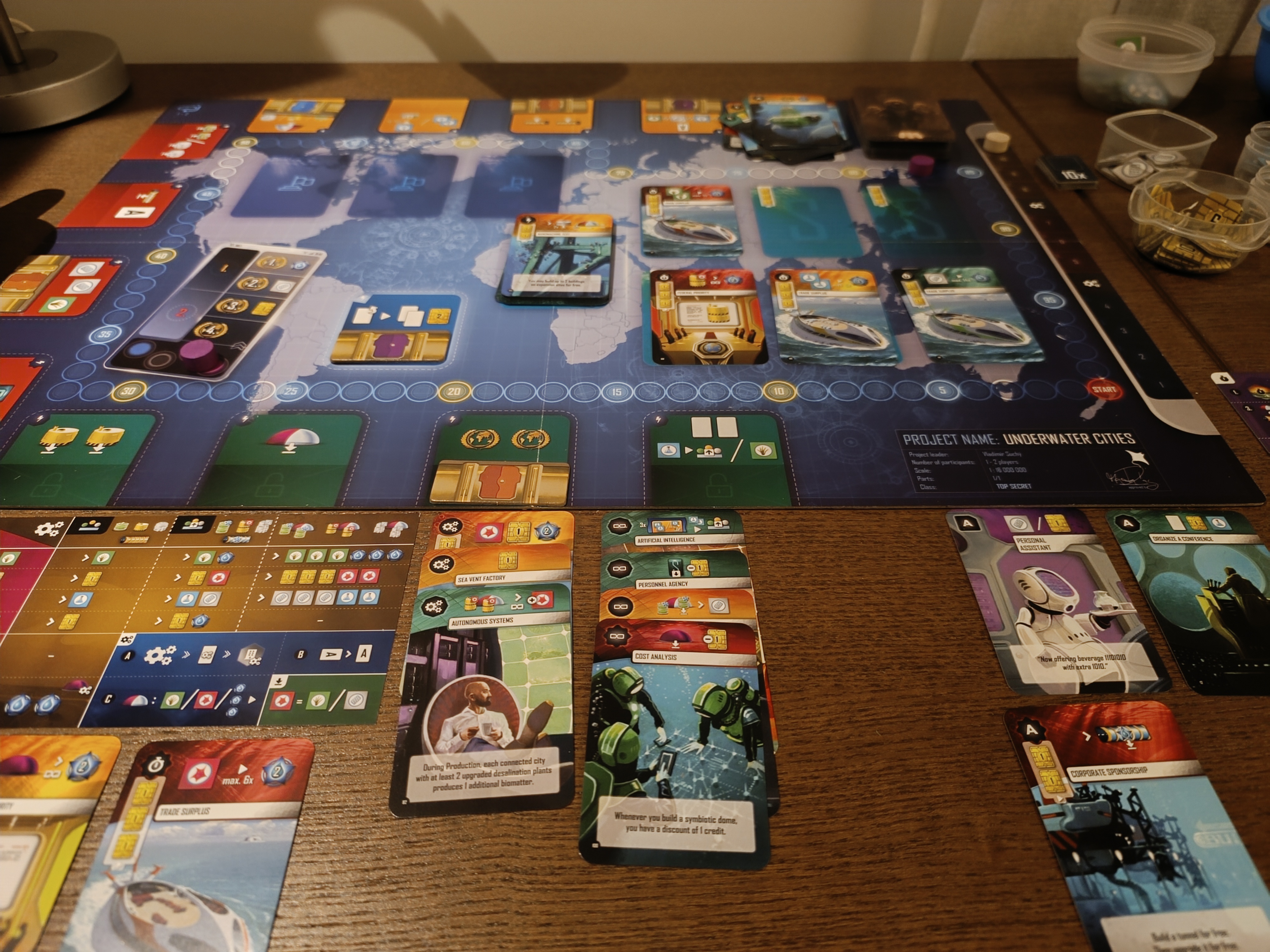
Main board and card tableau from a player
Comparing My Two Plays
I definitely improved between games — my score went from 72 on the first play to 83 on the second. The experience felt completely different because the player boards are asymmetric and I chose a different one for my second game. The cards that came into play were also so different that I needed to adjust to a completely different strategy.
I improved primarily by better utilizing the end-game scoring cards, special cards you can obtain using a specific action space. On my first play, I didn’t even consider those cards.
Strategic Depth
The game is really tight and each move must be carefully considered. During production phases, it seems like you’re producing lots of resources, but they’re never quite enough. You only have 3 production rounds in the entire game (one at the end of each era), and since you don’t play after the last production phase, you really only have 2 productive rounds. You’ll need to adjust your strategy based on the cards in your hand.
A Tough Decision
For example, in my second play during my last round, I thought I would score better with a particular end-game scoring tile. I realized later that I wouldn’t be able to fulfill its requirements. This happened because in my last round I focused on another strategy that wasn’t that effective — I wanted to do everything but couldn’t due to the lack of actions.
Expansions
Two expansions are available: New Discoveries (2019) and Data Era (2025).
New Discoveries brings improvements that should have been in the base game, including dual-layer player boards. It also adds cards, assistants, starting resources, and a new museum mechanism.
Data Era introduces a new resource type — data discs — which provide additional actions along with new buildings called data centers and a new city type: information cities. These additions provide new scoring opportunities. This expansion also brings material improvements for upgraded facilities.
I don’t own either expansion yet, so I haven’t tested them. It’s frustrating to have to purchase expansions for better quality materials. Either way, the game is excellent, so I’ll most likely purchase them sooner or later.
Final Thoughts
Rating: 8.5 out of 10
Even without being a big fan of BYOS and despite the material quality issues, I will rate this game an 8.5/10. The game is really pleasant to play and really challenging. It’s an expert board game that deserves a place in any board gamer’s collection.
I was reluctant to try it at first due to its not-so-appealing appearance, but I’m really happy I tested it. I recommend it.
Your Turn
Have you played Underwater Cities? What’s your experience with it? Do you own the expansions?
Related Links:
- BoardGameGeek
- Delicious Games (rules available in several languages)
Videos:
- 3 Minute Board Games – Great quick review of the game
- Underwater Cities Tutorial & Playthrough – JonGetsGames