Hello everyone!
Today I’m bringing you my plays from January. This month had fewer total plays but more depth with individual games.
January 2026 by the Numbers:
- 11 plays (compared to 17 in December)
- 5 different games
- 2 new-to-me games
- Most played: Welcome to the Moon (5 plays)
Life was busy this month, which resulted in fewer plays overall. However, I enjoyed focusing more deeply on individual games.
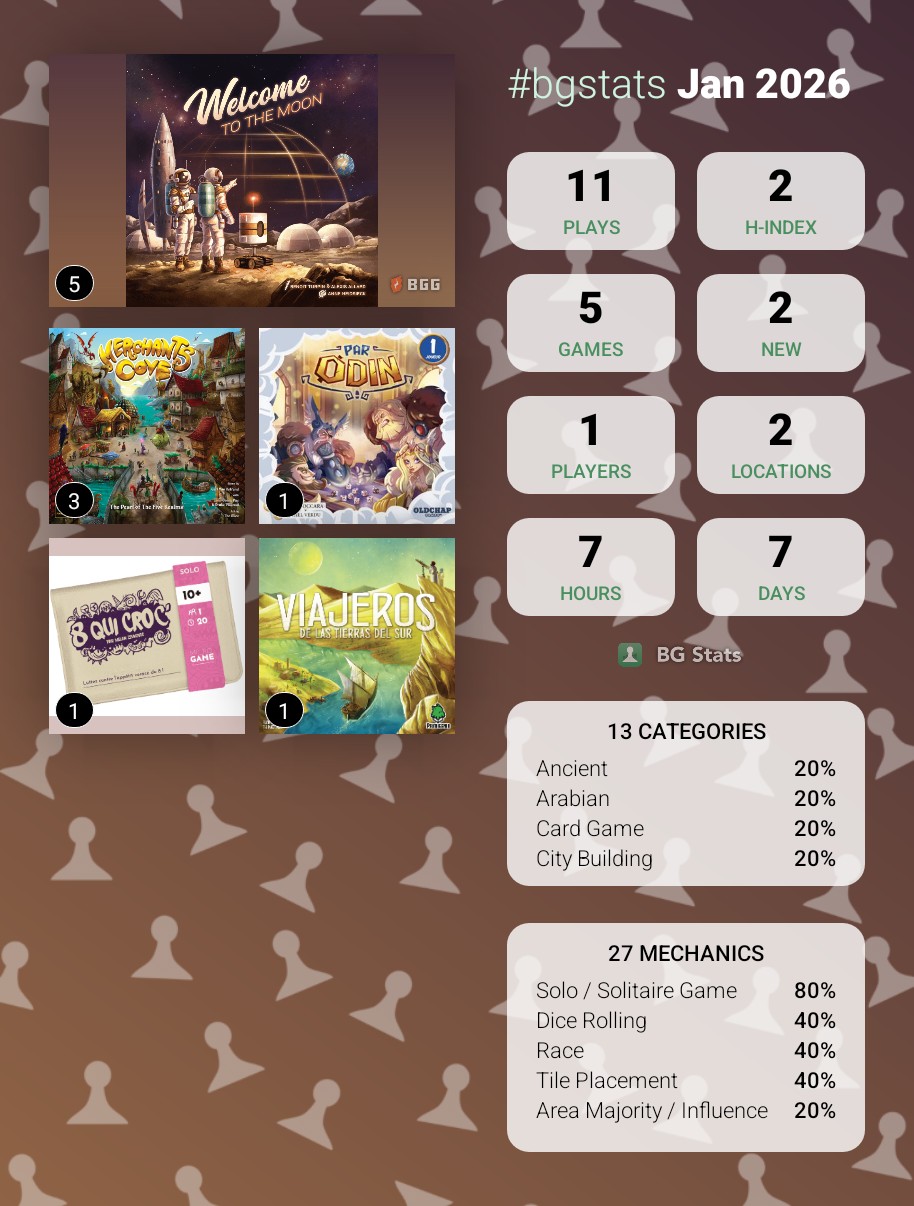
BG Stats of January
New Games Discovered
Wayfarers of the South Tigris – 1 play
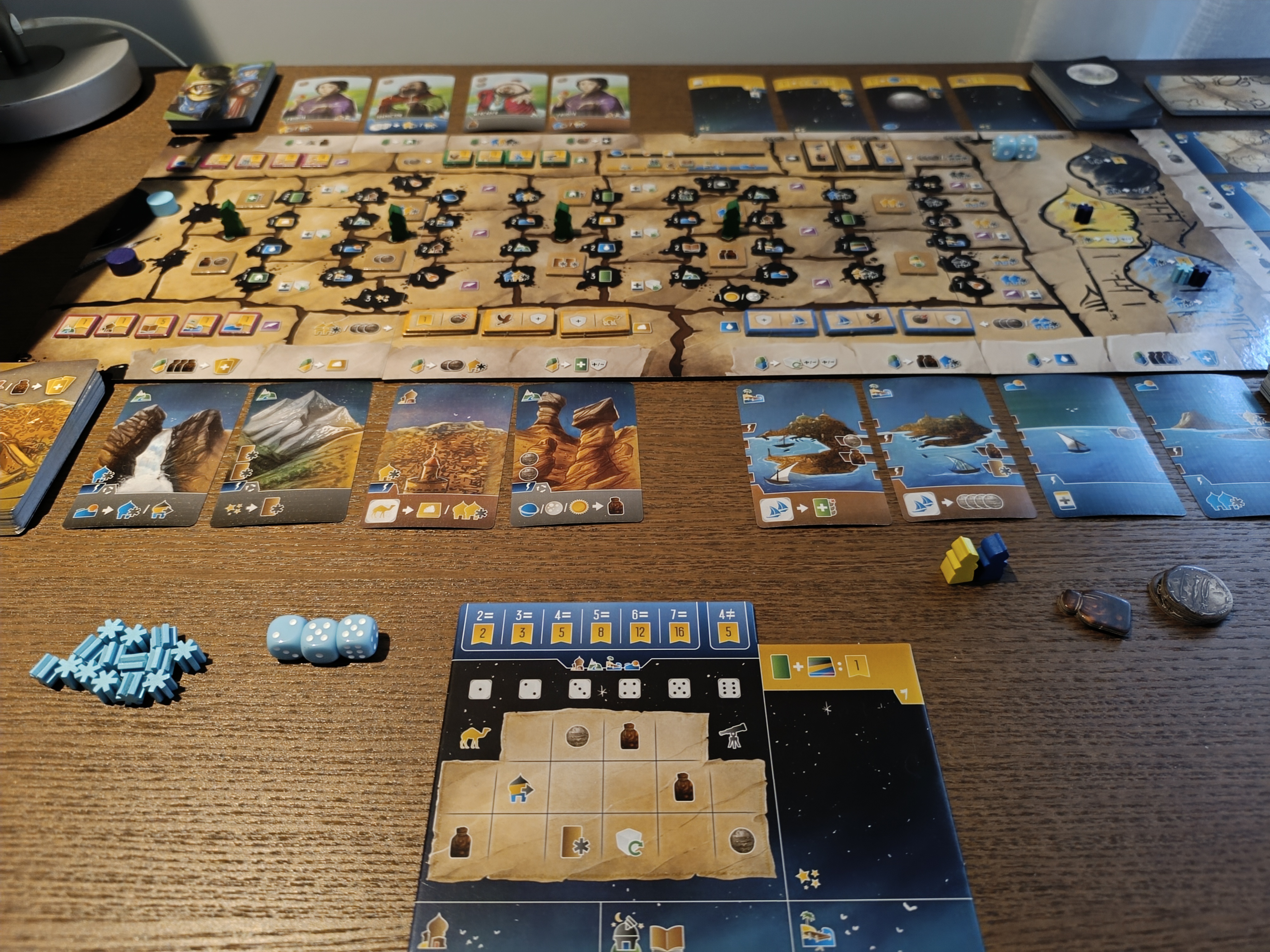
Wayfarers of the South Tigris – Setup
We are brave explorers, cartographers, and astronomers setting out from Baghdad to map the surrounding lands, sea, and sky. This 1-4 player game mixes several mechanics: worker placement, dice worker placement, set collection, and tile placement.
I enjoyed this first play, particularly the construction of the panorama, the possible combos, and the need for medium to long-term planning. These elements create satisfying strategic depth and give you goals to work toward across multiple rounds.
However, I found the rulebook confusing. At first glance, it seems well-written, but when actually playing, I had difficulties finding answers to my questions. After a closer look, the rulebook organization feels muddled, making it hard to reference during play. I needed to return to the rules several times, which disrupted the flow.
I need to replay at least 2 more times before forming a complete opinion, but the core gameplay shows promise despite the rulebook issues.
Numbsters – 1 play
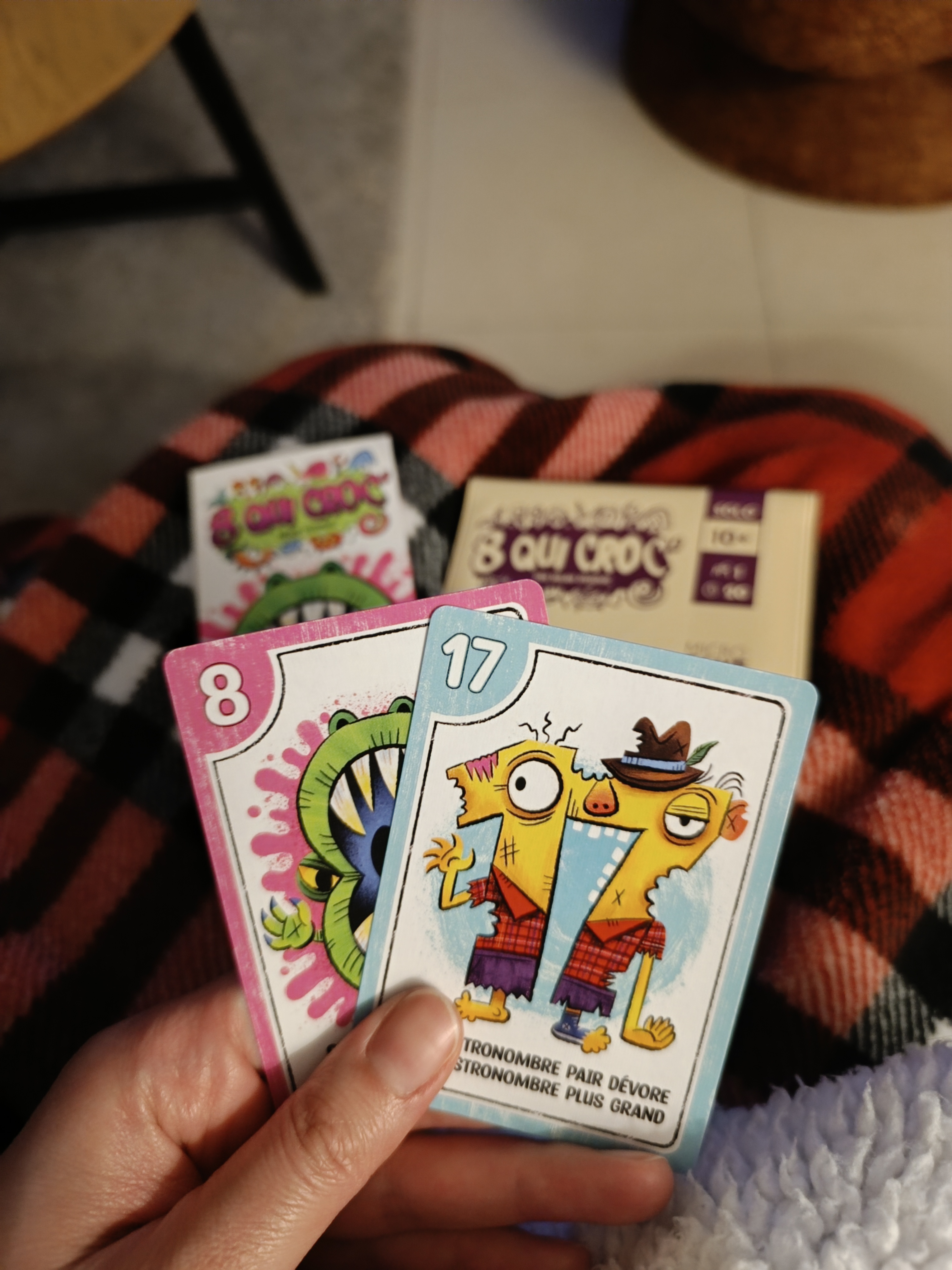
Numbsters – End of Game
A solo small game that’s perfect to carry anywhere. No table space needed, you can hold the cards in your hand! The theme is “Hungry Numbers,” and it consists entirely of cards with beautifully designed numbers.
The goal is to end with only the number 8 and one other card remaining. Crucially, the 8 must never be on top (the right side), you need the other card on top at the end, otherwise you lose.
Here’s how it works: At the start of each round, you can either move one card or use the power of the rightmost card (or top card if holding them in your hand).
The Eating Mechanic:
Even though it seems counterintuitive, smaller numbers eat bigger numbers! For a card to be eaten, the numbers must be sequential with the mouth card (the 8) in the middle. For example, if you have card 4, followed by 8, followed by 5, the 5 will be eaten because 4-5 are sequential around the 8.
The 8 can never be eaten. However, if the 8 ends up on the right side (or on top when holding cards), you lose.
Card Powers:
Card powers can change the eating rules, some eat the smallest card, others the biggest, some target even numbers, etc. When using a power, you still need to eat a card adjacent to the 8, but the card whose power you’re using doesn’t need to be adjacent, it just needs to be on the right side (or on top). After using a power, that card moves to the back (or left side).
I liked my first test. It’s really quick, easy to set up, and creates an interesting spatial puzzle. It’s not a bestseller, but I can see a lot of potential for travel or couch plays when you want a quick mental challenge.
Games I Continued Exploring
Par Odin – 1 play
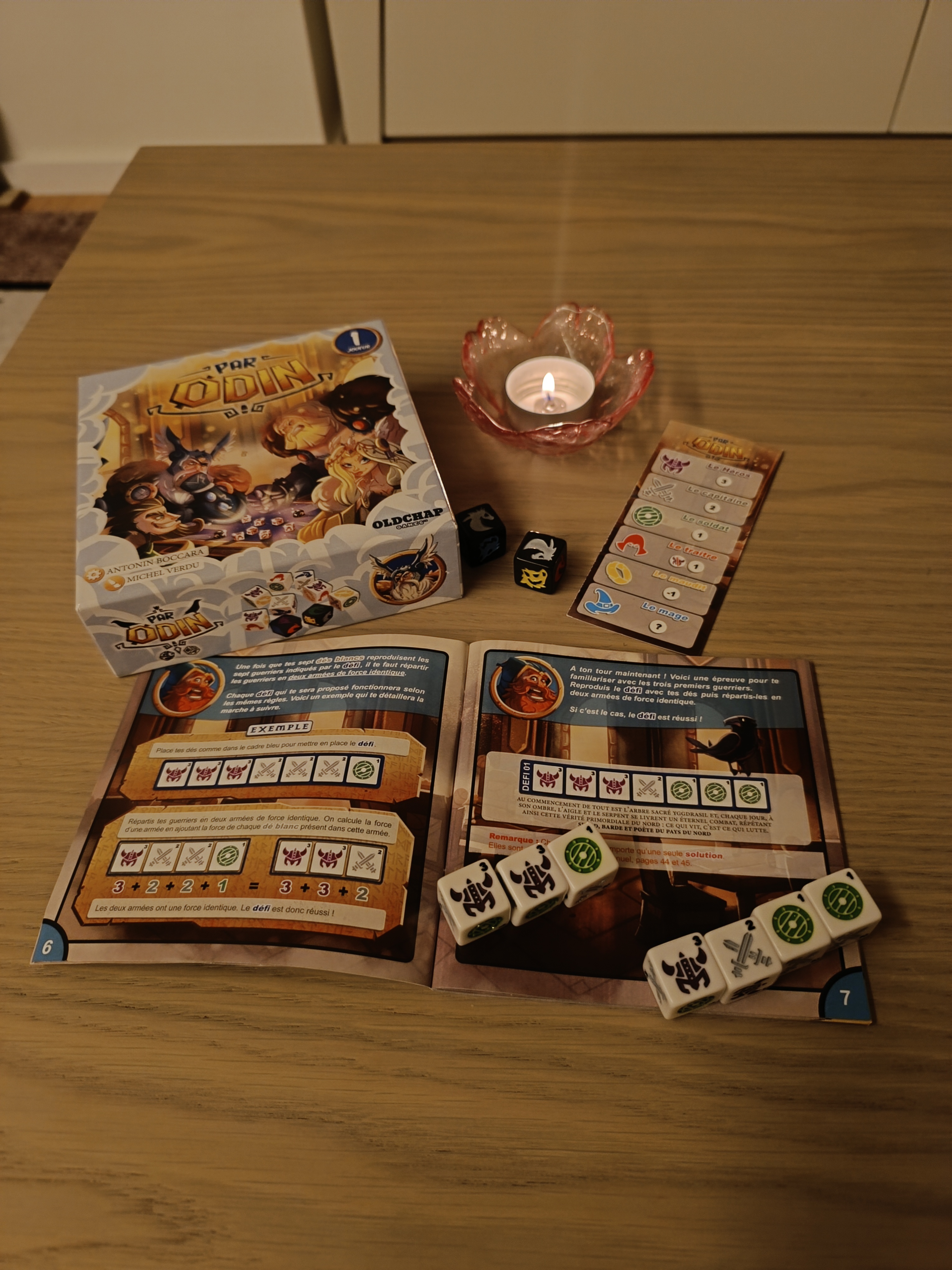
Par Odin
This isn’t a board game properly speaking, but rather a puzzle game. You have a set of figures represented by the sides of dice, and you need to split the dice into two groups where the sum of each group is equal.
Each character has different values and effects. For example, the ring removes 1 point from its group, while the mage has no point value itself but equals the sum of all white dice (non-mages) in the same group. These special effects add layers of complexity to what seems like a simple balancing puzzle.
I really like this game when I want something quick that makes me think. The puzzles are satisfying to solve, and the special character abilities keep things interesting across different challenges.
Welcome to the Moon – 5 plays
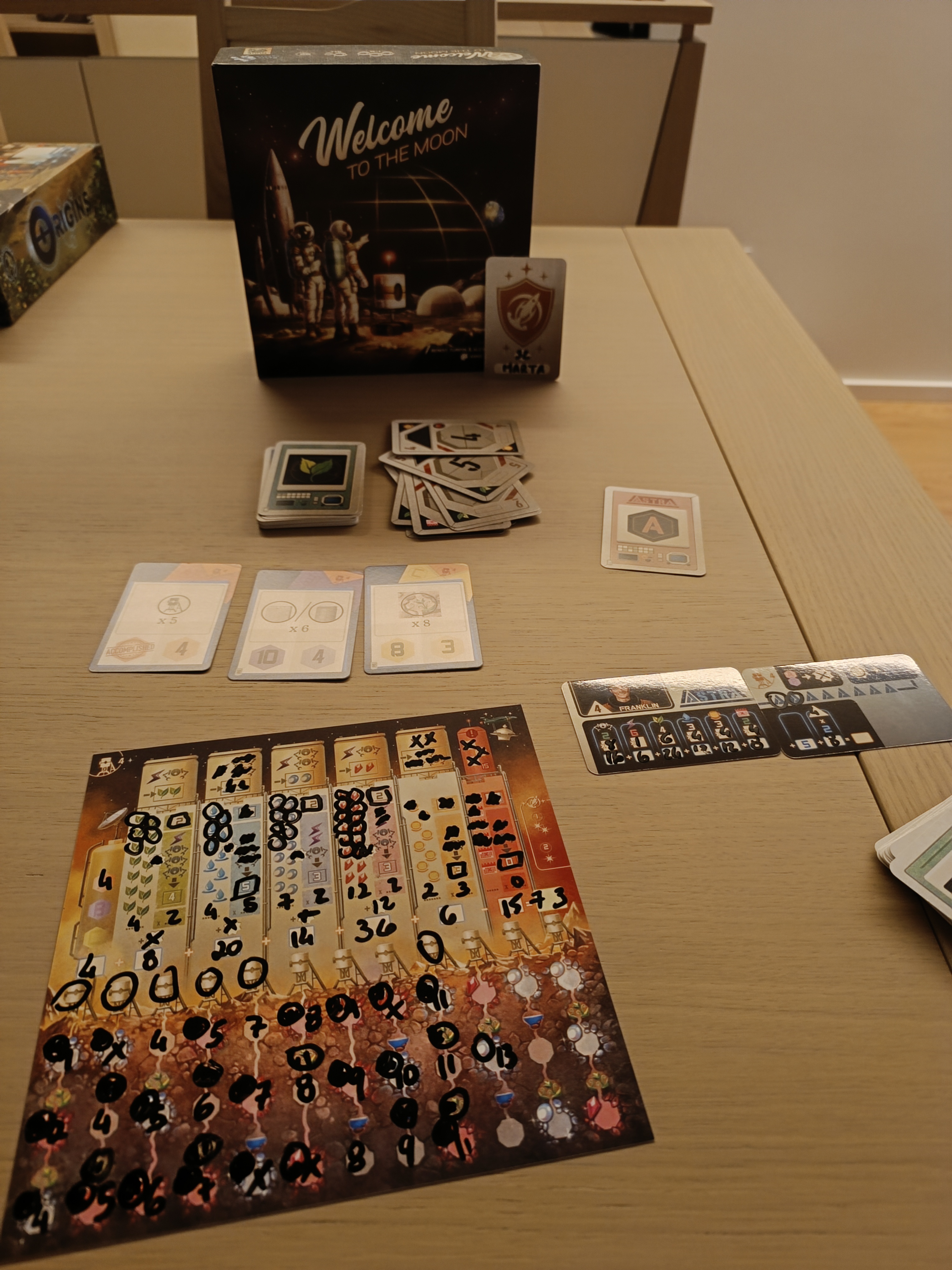
Welcome to The Moon – Adventure 4
I played this 5 times this month and will probably continue. As I mentioned in my dedicated review, the campaign side with different scenarios telling a cohesive story is really enjoyable. The increasing difficulty is also very pleasant, keeping each adventure challenging and fresh. The narrative progression from ship preparation through to lunar mining operations continues to engage me.
Merchants Cove – 3 plays
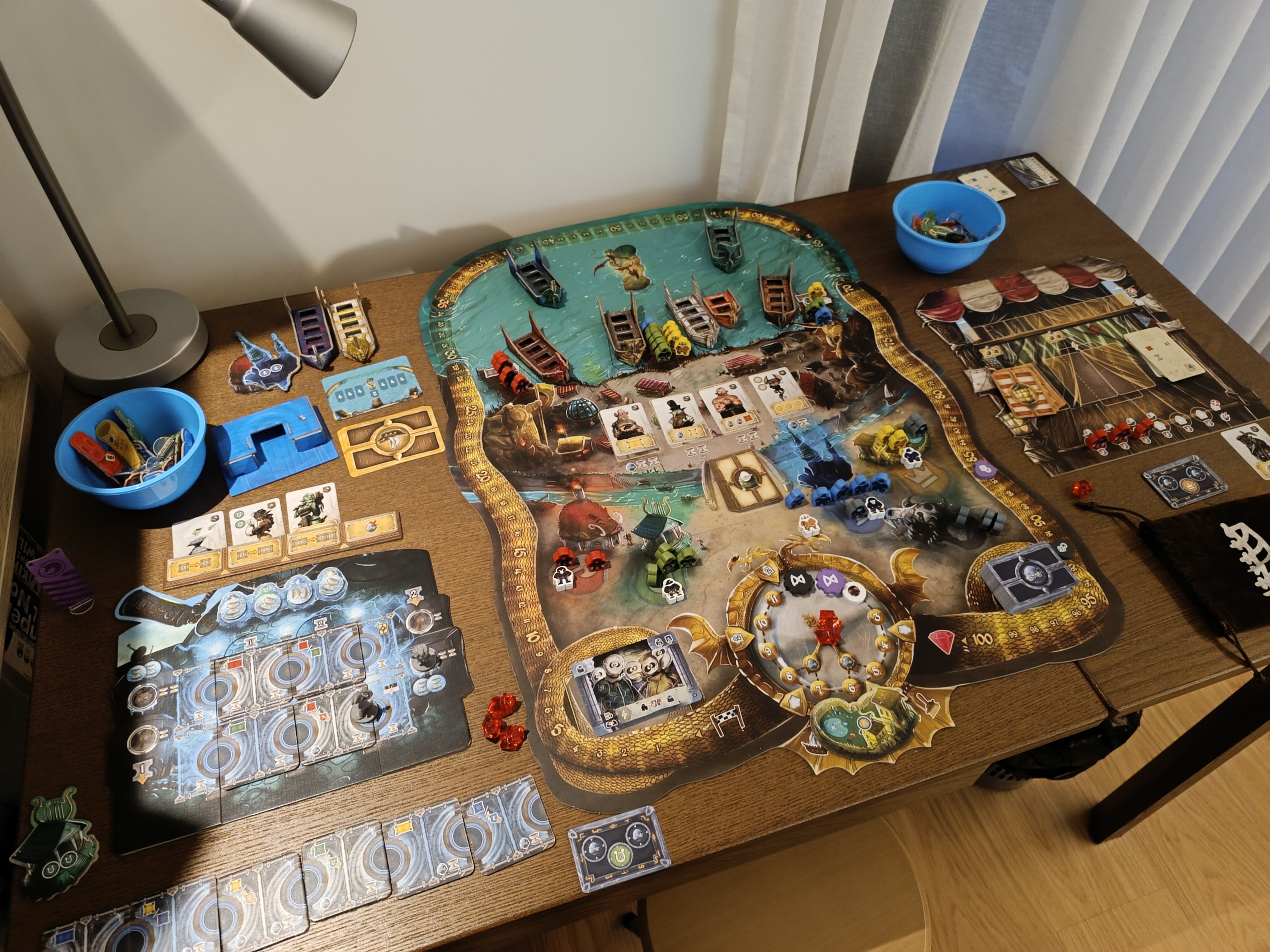
Merchants Cove and The Chronomancer with his assistant
An asymmetric game where each player is a merchant creating and selling merchandise to people arriving in the city by boat. There are 4 types of customers who can request 2 different types of goods: biggest or smallest.
Solo Mode:
The solo mode uses an automa managed by a set of cards. The goal is to beat the automa’s score, creating a competitive challenge even when playing alone.
Merchants Tested:
It’s enjoyable testing each merchant. So far, I’ve tested 6 merchants over time, I still have 5 to try! In solo mode, I’ve tested 3 merchants: the Alchemist, the Blacksmith, and the Chronomancer with his assistant.
I enjoyed playing each one, with the Chronomancer being my favorite of these three. He has the most creative mechanics, you travel across time and collect artifacts. You need to coordinate the two characters available as they have some constraints that create interesting puzzle moments. Managing both the Chronomancer and his assistant adds a unique strategic layer not present in the other merchants.
I’ll write a full review for this game once I’ve tested more merchants and can speak comprehensively about the variety they offer.
Looking Ahead to February
In my December 2025 year-in-review, I mentioned wanting to play Tapestry, but it wasn’t possible in January. It will probably be played during the next month.
I had a lot of fun with these games and will certainly play them again soon.
What were your most-played games in January? Are you exploring games deeply or trying lots of new ones?